Making Christmas Autism-Friendly: Your Practical Family Guide
August 9, 2026
You can make Christmas autism-friendly right now with three actions: reduce predictable sensory triggers, preserve your child's routine with a visual schedule, and set up a designated quiet space with a sensory toolkit ready to go.
Here is your instant checklist to print or screenshot:
- Reduce sensory triggers — swap flashing lights for warm steady ones, lower music volume, and limit strong-smelling candles or sprays.
- Share a visual schedule — show your child what will happen, when, and for how long, before the day arrives.
- Pack a sensory toolkit — noise-reducing headphones, a fidget, a comfort item, and a familiar snack in one bag.
One more step that pays off: tell hosts and venues about your child's needs before you arrive. A quick email or phone call removes the guesswork and gives everyone a better day.
Key Takeaways
An autism-friendly Christmas is built on one principle: reduce unpredictability first, then layer sensory supports and quiet spaces around whatever remains.
| Point | Details |
|---|---|
| Reduce sensory triggers first | Swap flashing lights for steady warm ones and limit strong smells before any event. |
| Build a visual schedule | Show your child the shape of the day in advance using pictures, icons, or short written labels. |
| Pack a sensory toolkit | Bring noise-reducing headphones, a fidget, a comfort item, and a familiar snack to every outing. |
| Designate a quiet space | Set up one decoration-free, low-light room at home or request one at any venue you visit. |
| Wonderlens for low-sensory magic | A personalized Santa video in your own home delivers holiday wonder without crowds, queues, or sensory overload. |
Table of Contents
- Why does Christmas feel so hard for autistic children?
- How do you plan an autism-friendly Christmas in advance?
- What should you pack in a sensory toolkit for Christmas?
- How do you choose sensory-friendly Christmas outings?
- How do you host a low-stress Christmas gathering at home?
- What are the best sensory-friendly activities and gifts?
- How do you prevent and respond to meltdowns during the holidays?
- What does the evidence say, and how do you use a printable checklist?
- How do you involve your autistic child in Christmas planning?
- How do you manage food challenges at Christmas?
- How do you help your child return to normal routines after Christmas?
- What the holiday season really asks of autistic families
- A low-sensory Santa moment your child can watch at home
- Authoritative resources and where to learn more
- Sources
Why does Christmas feel so hard for autistic children?
Christmas stacks demands that most children absorb without noticing, but for autistic children, those demands arrive all at once. The Autism Society identifies sensory overload, routine disruption, social anxiety, and meltdowns as the primary holiday stressors, and recommends planning, visual supports, and quiet spaces as the core response.
The sensory triggers alone are significant:
- Bright and flashing lights on trees, storefronts, and decorations
- Loud, unpredictable noise from music, crowds, and excited relatives
- Strong smells from candles, perfume, and cooking
- Novel textures in new clothing, wrapping paper, or unfamiliar foods
- Crowded, unpredictable spaces at malls, parties, and holiday events
Routine disruption adds another layer. School schedules change, mealtimes shift, and familiar anchors disappear for weeks. Social expectations pile on top: greet relatives, open gifts on cue, perform excitement. Each of those demands is manageable alone. Together, they create what specialists call trigger stacking, where multiple small changes accumulate into full overload faster than any single trigger would.
Stacking triggers matter. Caudwell Children's guidance notes that gradual decorating and Christmas-free zones at home directly reduce this accumulation effect, because they limit how many new inputs arrive at once.
Understanding this stacking pattern is what makes the practical steps below work. You are not just managing one problem; you are reducing the total load.
How do you plan an autism-friendly Christmas in advance?
The most effective holiday plans reduce unpredictability first, then layer sensory supports. Heartlinks ABA recommends visual timetables, social stories, countdowns, and rehearsal as the core preparation toolkit.
Build a visual schedule
A simple visual schedule shows your child the shape of the day before it happens. You can create one with pictures, icons, or short written labels depending on your child's communication style. Include:
- Wake-up time and morning routine (unchanged from normal)
- Travel or arrival time
- Key events with approximate durations ("open gifts: 20 minutes")
- Meal times
- Quiet break slots
- Departure or bedtime
Print it, laminate it, or keep it on a tablet. Review it together the night before and again that morning.
Use social stories and rehearsal scripts
A social story walks your child through an upcoming event in calm, first-person language: who will be there, what the space looks like, what will happen, and how long it lasts. Keep each story to five or six sentences. For a family gathering, include a sentence about the quiet room: "If I feel too loud inside, I can go to the blue room and take a break."
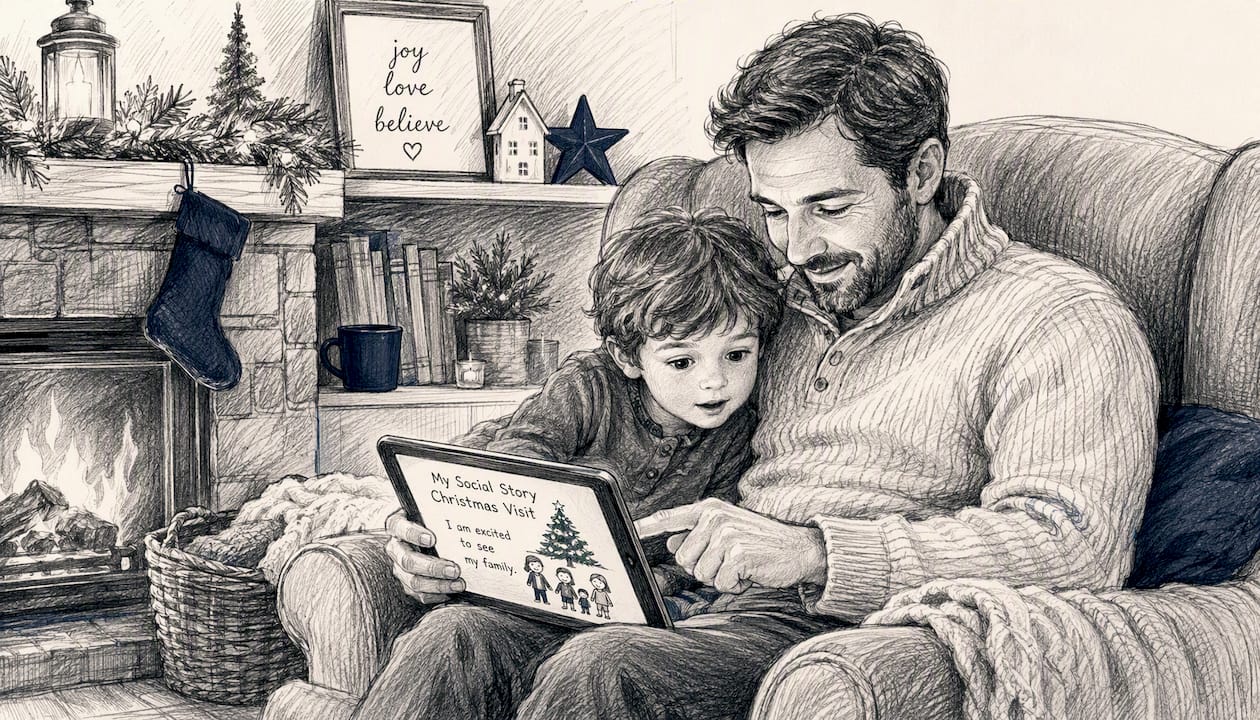
Rehearsal works alongside the story. If you can visit the venue beforehand, do it. If not, show photos or a short video walkthrough so the space is already familiar.
Communicate with family and venues
A short, direct message removes the awkward moment on the day. Try this template:
"Our child is autistic and does well with predictability. We'd love to let them greet people in their own time, have access to a quiet room, and keep the music at a lower volume. Thank you so much for understanding."
Practice at home first
- Introduce decorations gradually over several days, not all at once
- Sample holiday foods before the main meal so textures are not a surprise
- Practice a short version of gift-opening in a low-pressure setting
- Run through the visual schedule as a story before the real day
Pro Tip: If you can visit the venue in advance, even for five minutes, do it. If not, a short video walkthrough on your phone works almost as well. Familiarity with the space before the event lowers the novelty load significantly.
What should you pack in a sensory toolkit for Christmas?
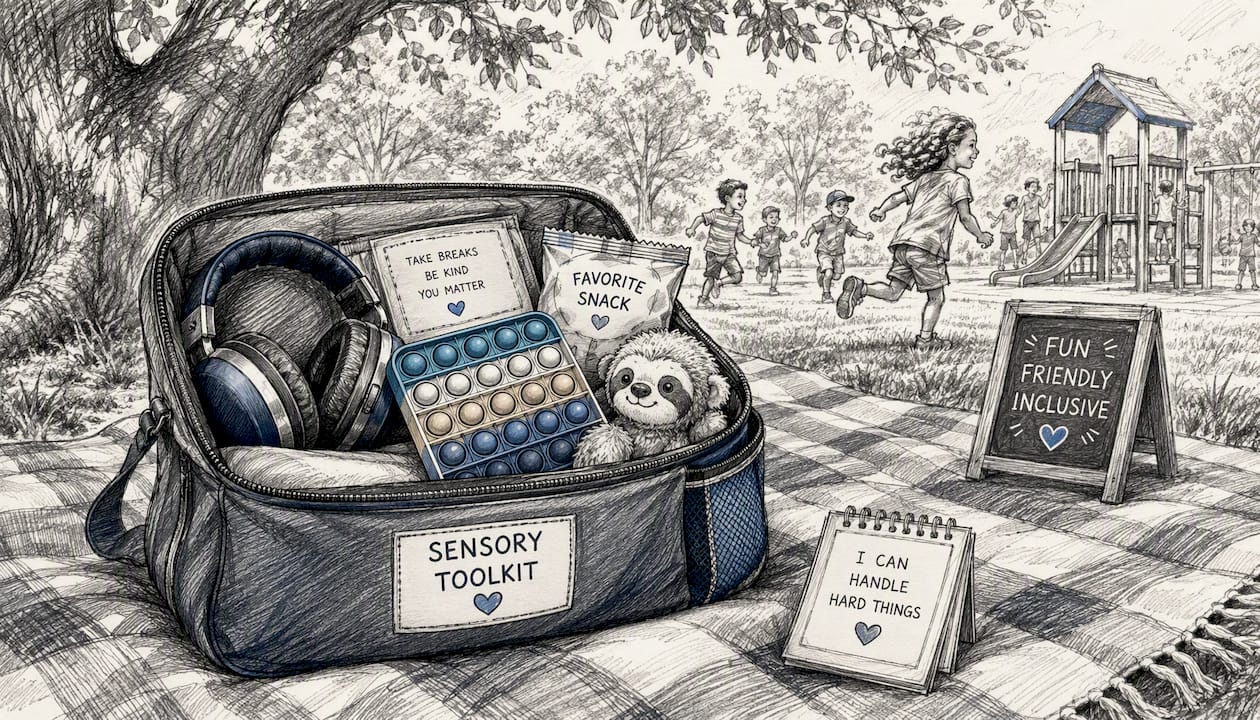
Sensory tools are functional supports, not optional extras. They directly reduce the most common triggers your child will face. Pack these before every holiday outing:
- Noise-reducing headphones or ear defenders — for loud music, crowds, and sudden sounds
- Sunglasses or a cap with a brim — for bright overhead lights and flashing displays
- Weighted lap pad or small weighted blanket — for proprioceptive calming during meals or downtime
- Fidget tools — a squeeze toy, tangle, or smooth stone for tactile regulation
- Preferred snack — a familiar, safe food that requires no negotiation
- Comfort item — a small toy, soft object, or familiar item from home
- Visual timer — a Time Timer or similar tool to show how long until a break or departure
- Non-perfumed wipes — for sticky hands, unfamiliar textures, or quick sensory resets
- Familiar small toy — something your child associates with calm, not novelty
For food management specifically, bring safe foods in their original packaging when possible. Offer choices rather than surprises. Never pressure tasting of new foods during an already stimulating event. HuffPost's caregiver guidance emphasizes keeping familiar foods available and allowing a separate plate to reduce mealtime stress.
Pro Tip: Pack duplicates of the most critical items (headphones, comfort object) and keep a small "emergency regulation kit" in the car: a spare fidget, a snack, and a printed copy of the visual schedule. If the bag gets left inside, you still have a backup.
How do you choose sensory-friendly Christmas outings?
The visit mechanics matter more than the event itself. At any Santa experience, what determines success is the queue length, the lighting level, the sound control, and whether your child can choose their own interaction level. The character appearance is secondary.
Sensory-friendly event formats to look for
- Sensory grottos with soft, adjustable lighting, no camera flash, and flexible timing. BBC News coverage of sensory grottos describes venues that use gentle sounds, adaptable lighting, and different textures to give children time and space at their own pace.
- Caring Santa or sensory Santa programs offered by some malls and venues, with reduced crowds and no-flash photography
- Drive-through light displays — your child stays in the car, controls the sensory input, and can leave at any moment
- Sensory-friendly performances at theaters, which typically reduce lighting intensity, lower sound levels, allow movement, and permit early exits
How to find and verify sensory-friendly listings
Call or email ahead and ask these specific questions:
- "Do you offer a sensory-friendly time slot or a quiet hour?"
- "Can we arrive early or at a low-traffic time?"
- "Is there a waiting area away from the main crowd?"
- "Do you allow noise-reducing headphones and comfort items?"
- "Is photography flash-free?"
Accommodation request script
"My child is autistic and sensitive to loud sounds and bright lights. We'd like to request a quieter time slot, a shorter wait, and permission to leave and re-enter if needed. Can you tell me what accommodations you offer?"
When the event is too high-risk
Skip it without guilt. A private booking, a visit at opening time, or a virtual alternative preserves the magic without the overload. Home-based activities, described in the next section, often create stronger memories than crowded public events anyway.
How do you host a low-stress Christmas gathering at home?
Hosting gives you the most control. Use it.
Decoration strategy
- Introduce decorations over several days rather than overnight
- Use warm, steady lights rather than flashing or motion-activated ones
- Keep at least one room completely decoration-free as a visual rest space
- Avoid motion-activated ornaments or singing decorations in rest areas
- Place strong-smelling items (candles, potpourri) away from the child's main spaces
Quiet-room setup
Designate one room before guests arrive. Equip it with:
- Soft, dimmable lighting
- A comfortable seat or floor cushion
- A few familiar sensory tools (fidget, weighted blanket)
- A visual signal on the door (a simple laminated card: "Quiet Room — Come In")
- No competing noise from TVs or speakers
The Autism Society recommends advising hosts in advance so the child has a predictable retreat space. If you are the host, you are already ahead.
Briefing family members
Send a short message before the gathering. Keep it warm and specific:
"We'd love for you to let [child's name] come to you for a hug when they're ready, rather than asking for one. They may need a break in the quiet room and that's completely normal. Please avoid strong perfumes if you can."
Assign one trusted adult as the child's point person for the day. That person knows the plan, knows the quiet room, and knows the exit signal.
Mealtime
Serve familiar foods first, before introducing anything new. Label dishes clearly. Allow a separate plate with only safe foods. Keep strong-smelling dishes (Brussels sprouts, spiced dishes) away from the child's seating area. The Autistic Girls Network encourages adapting traditions rather than insisting on typical holiday rituals, including food choices.
What are the best sensory-friendly activities and gifts?
Low-sensory activities
- Blanket fort building with fairy lights (child controls the setup)
- Quiet story time with a new book chosen by the child
- Simple holiday crafts: paper snowflakes, coloring pages, DIY fake snow (cornstarch and shaving cream, no mess, no heat)
- Watching a favorite holiday film at home with the volume set by the child
- A timed neighborhood light tour by car, with the child choosing when to go home
Sensory-engaging activities (for sensory-seeking children)
- Kinetic sand or cloud dough holiday shapes
- Movement-based activities: dancing to a chosen playlist, jumping on a trampoline
- Sensory bins with holiday themes (fake snow, pine cones, smooth ornaments)
Gift ideas by sensory profile
Calming: weighted blanket, soft-texture stuffed animal, noise-canceling headphones, lava lamp
Sensory-seeking: chewable jewelry, vibrating pillow, balance board, resistance band set
Interest-based: books, building kits, art supplies, or anything tied to the child's specific passion
Wrapping tip: some children find surprise unwrapping distressing. Let them open gifts privately, at their own pace, or even skip wrapping entirely for their main gift. The magic is in the item, not the paper.
Items to avoid or modify
- Loud, battery-operated toys with no volume control
- Flashing or motion-activated novelty items
- Surprise-only gift strategies with no preview or choice
Pro Tip: Before gift day, introduce a new toy in a calm, low-pressure moment. Let your child explore it without an audience. A toy that causes sensory distress in front of a crowd becomes a much harder moment to recover from than one you caught at home first.
How do you prevent and respond to meltdowns during the holidays?
Prevention steps
- Anticipate known triggers and reduce them before the event
- Schedule regular breaks into the visual timetable (every 45–60 minutes for most children)
- Agree on a quiet, private signal your child can use to request a break without having to speak
- Model calm yourself: slow your voice, lower your own stimulation level before events
- Use a first/then board for transitions: "First: dinner. Then: quiet room."
During a meltdown: what to do and what to avoid
| Do | Don't |
|---|---|
| Offer space and reduce noise immediately | Force eye contact or physical touch |
| Keep your voice low and calm | Raise your voice or demand explanation |
| Guide to the quiet room without commentary | Punish or shame the behavior |
| Use a familiar calming phrase or object | Introduce new demands or choices |
| Wait without pressure | Insist on an immediate return to the group |
Recovery after a meltdown
Recovery takes longer than the meltdown itself. After the peak passes:
- Debrief with minimal questions. One calm sentence is enough: "You're safe. Take your time."
- Restore a routine anchor: a familiar snack, a preferred activity, or a short walk
- Offer a preferred calming activity without conditions
- Plan the next transition gradually, using the visual schedule
Pro Tip: Keep a short "cool-down script" on your phone: three sentences you say in the same calm tone every time. Consistency in your response is itself a regulation tool. And give yourself a moment too. Staying regulated as a parent during a meltdown is hard work, and it matters.
What does the evidence say, and how do you use a printable checklist?
The research basis for these recommendations is consistent. The Autism Society, Heartlinks ABA, and Caudwell Children all converge on the same core framework: reduce unpredictability first (visual schedule, social story), then layer sensory supports (toolkit, quiet space), then adapt the social environment (brief family, modify traditions). Social stories and visual schedules reduce event-related anxiety by making the unknown known before it happens. Quiet spaces improve regulation and make gatherings more successful by giving the child a predictable retreat.
A printable one-page checklist for your family might include:
- Visual schedule template with blank time slots
- Sensory toolkit packing list (headphones, fidget, comfort item, snack, timer, wipes)
- Quiet-room setup checklist (lighting, seating, sensory tools, door signal)
- Event accommodation script (phone/email version)
- Meltdown response reminders (do/don't list)
Pro Tip: Laminate the checklist and store it with your holiday decorations. Each year, review it in early December and update it for your child's current needs. What worked at age five may need adjusting at age eight, but the structure stays the same.
How do you involve your autistic child in Christmas planning?
Giving your child a role in the planning is one of the most effective anxiety-reduction strategies available. When children help choose decorations, select foods, or decide which events to attend, the holiday shifts from something that happens to them to something they helped shape.
Start small. Let your child pick one decoration to place themselves. Ask whether they want the tree lights steady or off. Show them two options for a holiday activity and let them choose. These micro-decisions build a sense of control without overwhelming them with open-ended choices.
For older children, involve them in building the visual schedule. Sit together and fill in the time slots. Ask what they are looking forward to and what they want to skip. That conversation is itself a social story rehearsal.
The Autistic Girls Network notes that rethinking traditions and involving the child in planning leads to celebrations that work better for the whole family, not just the autistic child.
How do you manage food challenges at Christmas?
Holiday meals are a sensory event in themselves: unfamiliar smells, new textures, foods touching each other on the plate, and social pressure to eat what everyone else is eating. For autistic children with food sensitivities or restricted diets, this is one of the highest-risk moments of the season.
The most practical approach is to protect the safe foods first. Bring your child's preferred foods to any gathering, even if the host is cooking. Serve them first, before anything new appears on the table. Use a separate plate with a clear boundary between foods if mixing is distressing.
Never use a holiday meal as an opportunity to push new foods. The combination of social pressure, sensory overload, and novelty makes acceptance far less likely than on a calm Tuesday at home. If you want to introduce a holiday food, do it in a low-pressure moment days before the event.
Label dishes at gatherings so your child can see what is in each one. A small card next to each dish ("mashed potatoes, butter only") removes the uncertainty that often triggers refusal. HuffPost's caregiver guidance specifically recommends keeping familiar foods available and allowing a separate plate to reduce mealtime stress.
How do you help your child return to normal routines after Christmas?
The post-holiday transition is often harder than the holiday itself. School is out, sleep schedules drift, and the sensory environment at home changes again as decorations come down. For autistic children, this second disruption can trigger a new wave of dysregulation.
Start the transition gradually. If decorations went up slowly, take them down slowly too. Remove one or two items per day rather than clearing the house in one afternoon. Restore the pre-holiday bedtime and morning routine as soon as possible, even before school resumes.
Use the visual schedule again for the transition period. Show your child what the week looks like as things return to normal. A simple "back to routine" schedule with familiar anchors (breakfast time, screen time, outdoor time) gives the return to normal the same predictability you built into the holiday.
Watch for delayed stress responses. Some children hold it together during the holiday and then struggle in the days after. Increased irritability, sleep disruption, or withdrawal in early January often reflects the accumulated cost of the holiday period. Reduce demands, increase preferred activities, and give extra quiet time during this window.
What the holiday season really asks of autistic families
The conventional advice about autism and Christmas tends to focus on managing the child. What gets less attention is the emotional weight on parents and caregivers who are simultaneously planning, adapting, briefing relatives, packing toolkits, and trying to preserve some magic in the middle of it all.
Here is what I think gets missed: the goal is not a perfect Christmas. The goal is a Christmas your child can actually be present for. That might mean pizza instead of a traditional dinner. It might mean a private Santa visit at 9 AM before the crowds arrive, or skipping the school concert entirely and watching a favorite film at home instead.
Those adaptations are not failures. They are the whole point. A child who finishes Christmas Day regulated and connected has had a better holiday than one who endured every tradition and spent the evening in meltdown recovery.
The families who navigate this well are not the ones who planned the most. They are the ones who stayed flexible, followed their child's lead, and gave themselves permission to do Christmas differently.
A low-sensory Santa moment your child can watch at home
For families who want to skip the crowded grotto entirely, Wonderlens offers something genuinely different: a personalized, 10-second animated video of Santa walking through your actual living room, rendered with realistic lighting, shadows, and movement using AI.
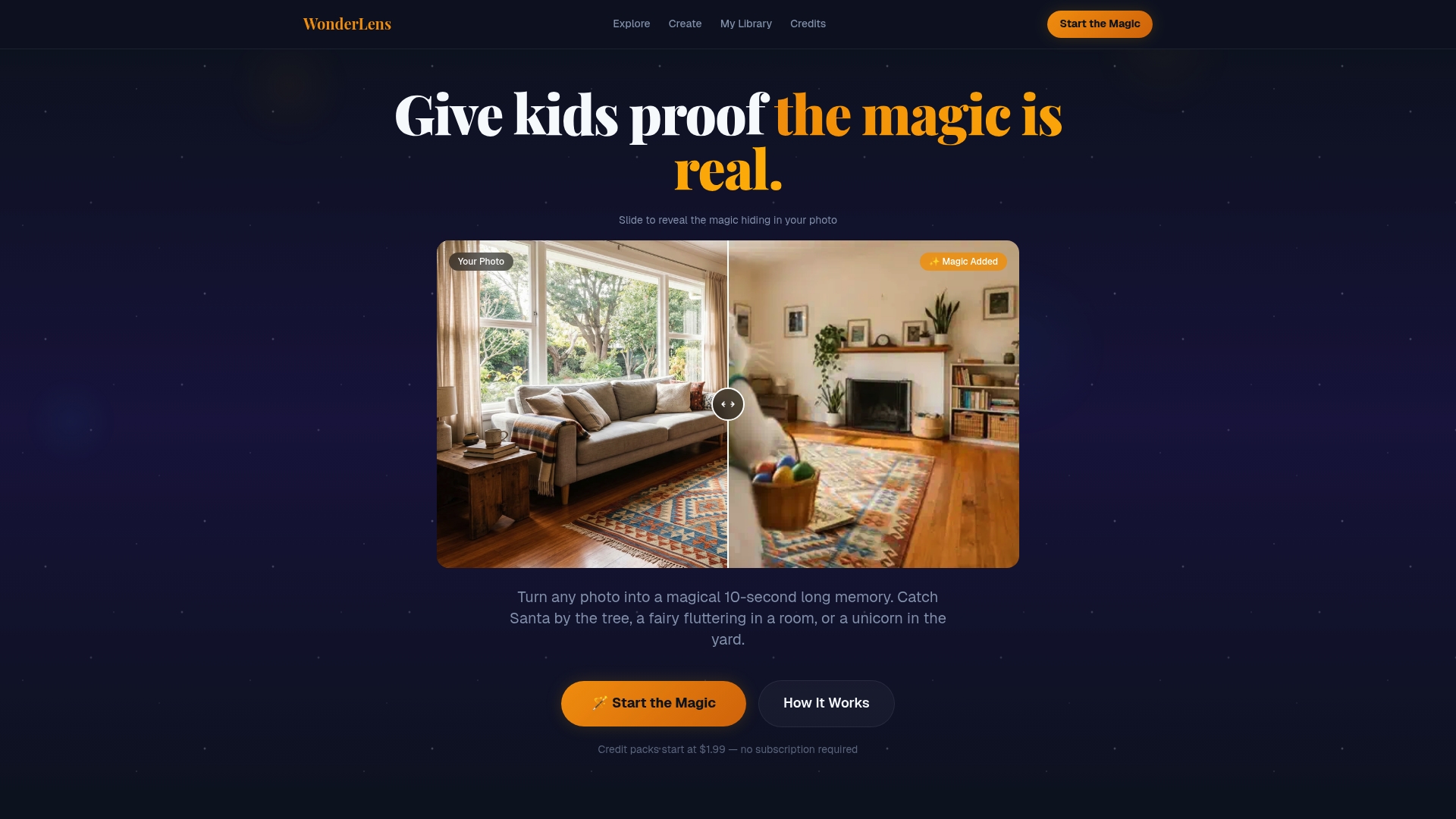
You upload a photo of your home, choose your character, and Wonderlens places Santa (or a fairy, dragon, unicorn, or superhero) into your space with cinematic-quality animation. The result is a Santa video in your living room your child can watch as many times as they want, at whatever volume they choose, with no queue, no crowds, and no sensory surprises. Credits start at $1.99. The first video is free.
This is not a medical intervention or a replacement for professional support. It is simply a way to bring a little holiday magic home, on your child's terms. Visit Wonderlens to create your family's personalized holiday memory.
Authoritative resources and where to learn more
- Autism Society: Creating an Autism-Friendly Holiday — comprehensive holiday guidance covering sensory stacking, visual supports, and quiet spaces; one of the most cited resources in this space.
- Caudwell Children: Autism-Friendly Christmas Tips — UK charity guidance with practical decorating strategies, gradual introduction tips, and family briefing scripts.
- Heartlinks ABA: Christmas and Autism Holiday Survival Guide — ABA-informed preparation tools including visual timetables, social stories, first/then boards, and countdown strategies.
- BBC News: Sensory Grotto Coverage — real-world example of a sensory-friendly Santa grotto with details on lighting, sound, and visit mechanics; useful for knowing what to ask venues.
- HuffPost UK: How To Help Your Autistic Child Have a Calm Christmas — caregiver-focused practical advice on routines, familiar foods, and managing social pressure during the holiday season.
- Autistic Girls Network: An Autistic Friendly Christmas — community-led perspective on adapting traditions, involving children in planning, and rethinking what holiday success looks like.
This article is general information, not a substitute for advice from a qualified doctor. Consult a qualified healthcare professional about your own circumstances before acting on anything here.
Sources
- Creating an Autism-Friendly Holiday: Strategies for a Joyful Season | Autism Society
- An Inclusive and Joyful Christmas: Tips for an Autism-Friendly Celebration - Caudwell Children
- Sensory grotto makes Santa visits accessible — BBC News
- Autism Christmas guide: Tips & strategies for a calm holiday | Heartlinks ABA
- How To Help Your Autistic Child Have A Calm Christmas | HuffPost UK Parents
Recommended
- Christmas Tradition Enhancement Tips for Families. WonderLens | WonderLens
- Holiday Animation for Parents: a Creative Family Guide — WonderLens | WonderLens
- Best practices for creating unforgettable holiday magic — WonderLens | WonderLens
- Types of Holiday Animations: A Family Guide for 2026. WonderLens | WonderLens