Creating Personalized Family Memories That Truly Last
May 23, 2026
Special occasions feel different when you're actually present in them. But between packed schedules, overflowing photo rolls, and the pressure to "do something memorable," creating personalized family memories can slip from a joy into a to-do. This guide gives you a practical, research-informed path through the whole process. From gathering the right materials and choosing creative formats, to using sensory cues that deepen recall and technology that brings wonder into your living room, every step here is designed to help your family build memories that actually stick.
Table of Contents
- Key takeaways
- Gathering materials for personalized memory-making
- Step-by-step ways to personalize family memories
- How to deepen recall and emotional impact
- Common challenges and how to handle them
- What you gain from building this habit
- My honest take on all of this
- Bring the magic home with Wonderlens
- FAQ
Key takeaways
| Point | Details |
|---|---|
| Start with what you already have | Gather existing photos, mementos, and family stories before buying anything new. |
| Combine novelty with familiarity | New experiences anchored to familiar traditions produce richer, more vivid memories. |
| Revisit memories more than once | Iterative storytelling, returning to photos and stories repeatedly, deepens emotional recall significantly. |
| Mix physical and digital formats | Physical albums and tangible keepsakes support deeper reflection than digital-only sharing. |
| Keep capture rhythms realistic | One meaningful photo or note per day beats a frantic end-of-vacation photo dump. |
Gathering materials for personalized memory-making
Before you create anything, you need raw material. And the best raw material is already scattered around your home, your phone, and your relatives' attic.
Start by pulling together photos that trigger a specific moment rather than just a place or year. A photo of your daughter mid-laugh at the Thanksgiving table is more powerful than a posed holiday shot. Structured photo-elicitation techniques, where photos are paired with structured questions rather than broad open-ended prompts, have been shown to significantly strengthen intergenerational family memory reconstruction across four generations.
Here is what to collect and how to organize it:
- Photos with context. Pull 15 to 20 images that represent specific moments, not just milestones. Include blurry, imperfect ones. Those often carry the most emotional honesty.
- Physical mementos. Ticket stubs, hand-drawn birthday cards, a child's first school project. These serve as sensory anchors that bring detail to stories.
- Family voices. Text or call relatives and ask three specific questions: What is your favorite memory of a holiday together? What tradition do you remember most? What is one thing you never want us to forget? Specific prompts produce far richer answers than "tell me a memory."
- A simple digital folder. Organize scanned or photographed items in one place before you start building anything. Trying to create while hunting for materials kills momentum.
| Tool type | Best for | Cost range |
|---|---|---|
| Flatbed scanner or phone app | Scanning old printed photos | Free to $30 |
| Shared cloud album | Collecting photos from multiple family members | Free |
| Voice memo or recording app | Capturing relatives' spoken stories | Free |
| Memory prompt cards | Sparking conversation at family gatherings | $10 to $25 |
Pro Tip: When reaching out to older relatives, send one question at a time over text rather than a long list. A single question is far less intimidating and gets real, detailed answers.
Step-by-step ways to personalize family memories
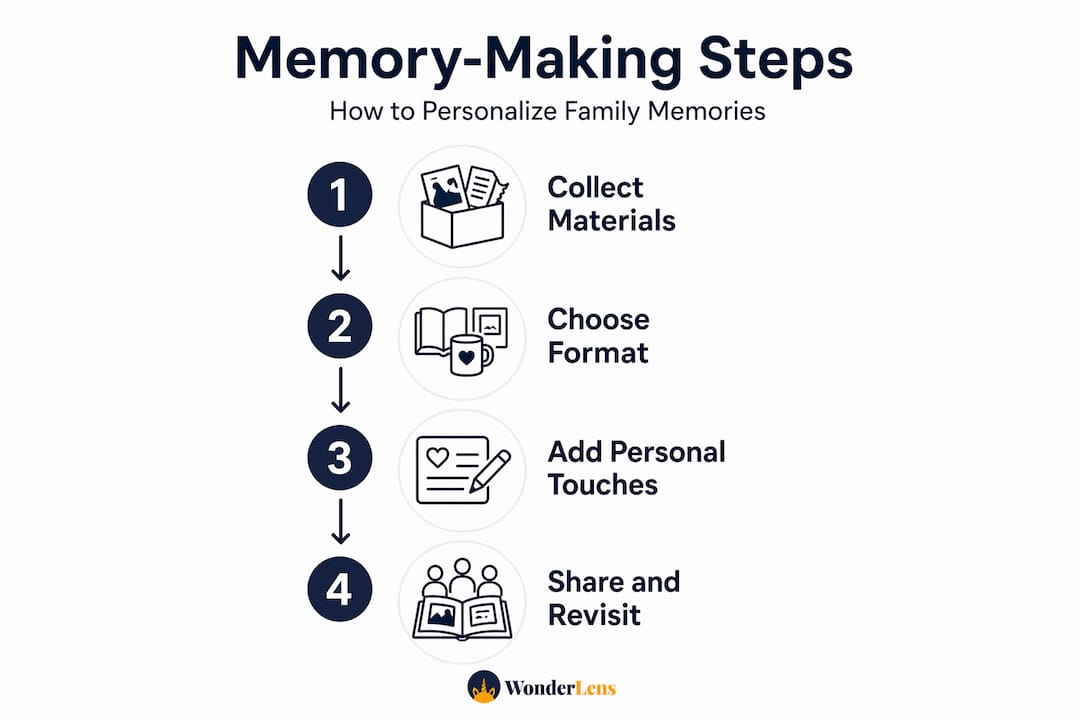
Once your materials are ready, the creative work begins. The good news: you do not need to be a designer or a scrapbooking expert. You need a format that fits your family and the willingness to follow through.
Here are five methods that work, each producing a different kind of keepsake:
-
Build a memory book with a narrative spine. Do not just drop photos in chronological order. Use a three-step approach: scan and select photos, gather written and spoken memories, then design with story elements like timelines, maps, and interview-style Q&A. A book structured around a theme, say, "all our Christmases" or "the summer we moved," feels like a story rather than a catalog.
-
Create a collaborative art display. Give each family member a canvas square and ask them to paint or collage their favorite shared memory. Frame them together. The result is genuinely one-of-a-kind and doubles as wall decor that sparks conversation every time someone sees it.
-
Start a shared traditions ritual. Pick one new activity per special occasion and let a different family member choose it each time. Allowing each person to choose one activity per occasion creates shared ownership and makes every event feel personal rather than repetitive.
-
Host a story night. This is simpler than it sounds. Gather around the table, pull out a box of old photos, and let conversations unfold naturally. Low-pressure story nights work better for genuine memory collection than structured interviews because people relax and share more when they do not feel on the spot.
-
Add a magical animated moment. Technology now makes it possible to place animated fantasy or holiday characters directly into your home environment, with realistic lighting and movement. Wonderlens does exactly this, and a 10-second video of Santa appearing in your living room becomes a personalized animated keepsake that children revisit for years.
Pro Tip: For memory books, write captions in the first person and include the date and one sensory detail, like "It smelled like pine and cinnamon." Sensory details are the fastest way to bring a memory back to life when you read it years later.
How to deepen recall and emotional impact
Making the memory is only half the work. The other half is making it stick. Research shows that how you revisit a memory matters just as much as how you captured it.
The single most underrated practice is returning to your materials more than once. Iterative memory externalization, the process of revisiting and adding detail to a recalled moment in multiple sessions, significantly increases subjective memory vividness. In practice, this means looking at your holiday photos twice: once right after to capture emotional warmth, and again a few weeks later to add the details and context that emerge with distance.
Sensory cues are another powerful tool. Viewing childlike familiar objects during memory recall, like a childhood toy or a parent's old sweater, measurably improves autobiographical memory specificity. Bring these objects out during story nights. Let your kids hold grandma's old ornament while she talks about what Christmas looked like when she was their age.
The novelty-familiarity balance matters more than most parents realize. Events with both novelty and familiarity are recalled with greater vividness and produce stronger positive emotions than purely routine or purely unfamiliar experiences. This is why adding one new tradition to an existing holiday works so well. It anchors the new experience to a familiar emotional scaffold, making both feel more memorable. Family traditions that blend old and new consistently outperform both rigid repetition and random new activities.
"The richest memories come not from perfect moments, but from layered ones. When something familiar holds something surprising inside it, the brain pays attention."
Low-pressure activities are where genuine memory material surfaces. Keep a small notebook in the kitchen and let family members write one favorite moment from the day, just one sentence, before bed. That daily favorite moment notebook, revisited at year's end, becomes something far more moving than any posed photo album.
Common challenges and how to handle them
Even the most motivated families run into real obstacles. Here is how to work through the most common ones.
Uneven photo archives are almost universal. You have hundreds of photos from the last three years and almost none from a decade ago. Compensate by gathering stories from relatives proactively and capturing current moments with greater intentionality. A handwritten description of a memory is more valuable than a missing photo.
Digital fatigue is real. Scrolling through a phone gallery does not produce the same reflection as flipping through a physical album. Physical albums support deeper memory processing than digital ephemeral sharing. Print your best 20 photos from each year and put them somewhere people will actually touch them.
Overwhelmed capture schedules kill consistency. You do not need to document everything. A realistic cadence like one intentional photo at the end of each day paired with a short caption sustains an archive far better than burst-capturing every event and then editing nothing.
| Challenge | Common mistake | Better approach |
|---|---|---|
| Gaps in old photos | Giving up on those years | Gather written stories from relatives to fill the gaps |
| Too many digital photos | Keeping all of them | Shortlist 15 to 20 per event and caption them promptly |
| Low family engagement | Forcing participation | Offer low-pressure formats like one-sentence daily notes |
| Tech overwhelm | Over-complicated apps | Use physical reflection tokens alongside digital tools |
Pro Tip: Assign one family member per occasion as the "memory keeper" on rotation. That person is responsible for capturing one photo, writing one sentence, and storing one physical item. Rotation prevents the task from always falling on the same person.
What you gain from building this habit
When families invest consistently in personalized family experiences, the benefits compound over time. Here is what changes:
- Storytelling gets richer. Family members start connecting present moments to past ones naturally, without prompting. Children begin to understand their own history as something vivid and ongoing.
- Identity strengthens across generations. When grandparents can point to photos and stories that grandchildren helped create, the sense of belonging deepens in both directions.
- Traditions become self-reinforcing. Once a family has a memory book, a story night habit, or a magical video from last Christmas, they want to add to it. The collection motivates more collection.
- Legacy becomes tangible. Memory books, annotated photo albums, and even short animated videos can be passed down. Future generations get context, not just faces.
The first project is always the hardest. But once it exists, every subsequent memory adds to something that already has shape and weight.
My honest take on all of this
In my experience, the families who make the most meaningful memories are not the ones with the biggest budgets or the most elaborate traditions. They are the ones who treat imperfection as part of the story.
I have seen parents spend weeks designing a perfect memory book, only to feel deflated when it does not match what they envisioned. The ones who get the most out of this process are the ones who let the crooked photo, the misspelled caption, and the chaotic dinner table moment stay in the record.
What surprised me most working with intergenerational storytelling is how much the older generation wants to be asked. Grandparents often hold memories they assume no one cares about. One specific question, asked warmly, can unlock stories that change how a whole family understands itself.
The tension between technology and tactile experience is real, but it is a false choice. A physical album and a 10-second animated video of a dragon landing in your backyard are not competing. They are serving different emotional registers. Both have a place. The key is being intentional about which tool serves which moment.
Start small. Finish one thing. Then build from there.
— Jeremiha
Bring the magic home with Wonderlens
If you want to add something truly unexpected to your family's memory collection this year, Wonderlens makes it simple. The platform places cinematic-quality animated characters, think Santa walking through your actual living room, a fairy hovering by the Christmas tree, a dragon landing in your backyard, directly into your home environment using AI-driven lighting and shadow rendering.

The result is not a sticker overlay or a basic AR filter. It is a 10-second shareable video that looks like the magic actually happened in your space. Upload a photo of your room, choose your character, and Wonderlens generates a short video your kids will want to watch again and again. It works beautifully as a standalone keepsake or as part of a larger memory book or story night. Credits start at just $1.99, and each video is family-friendly and easy to share.
Ready to create something your kids will never forget? Start making memories with Wonderlens today and see what real cinematic magic looks like in your home.
FAQ
What is the best way to start creating family memories?
Start by gathering 15 to 20 meaningful photos and asking relatives three specific memory-focused questions. Structured photo prompts produce far richer stories than broad open-ended requests.
How do you make personalized memory keepsakes that last?
Combine physical formats like printed photo albums with digital options for maximum longevity. Physical albums support deeper reflection and are more likely to be revisited and passed down than digital-only archives.
How often should families capture memories to avoid burnout?
One intentional photo per day with a short caption is more sustainable and produces a richer archive than trying to document every moment. Consistency matters more than volume.
Can technology help with building family bonds through memories?
Yes. Tools like personalized animated videos add novelty to familiar occasions, and research shows that combining novelty with familiarity produces more vivid, emotionally positive memories than routine experiences alone.
What do you do when old family photos are missing?
Compensate by gathering written or spoken stories from older relatives and capturing current moments with more intention. A detailed written memory is more valuable than a missing photo and often reveals context that images cannot carry.
Recommended
- Why create magical memories? Real value for your family — WonderLens | WonderLens
- What makes a digital experience truly memorable for families? — WonderLens | WonderLens
- Why Realism Enhances Family Memories That Truly Last — WonderLens | WonderLens
- 10 Magical Memories to Create With Personalized Animated Videos — WonderLens | WonderLens