Why Realism Enhances Family Memories That Truly Last
May 20, 2026
There is a quiet misconception most families carry: that the most memorable moments have to be perfect, polished, or extraordinary. But why realism enhances family memories has nothing to do with perfection. Memory science points in a different direction entirely. The details that stick are not the idealized ones. They are the real ones. The smell of your kitchen on Christmas morning. The specific chair your grandmother always sat in. The sound of your child laughing at something small and unexpected. These concrete, sensory anchors are what make memories retrievable, shareable, and emotionally lasting.
Table of Contents
- Key Takeaways
- Why realism enhances family memories: the science of retrieval
- Emotional salience and why feelings alone are not enough
- Realistic storytelling and how it builds shared family memory
- Practical ways to build realism into everyday family moments
- My honest take on realism and family memory
- Bring your family's real moments to magical life with Wonderlens
- FAQ
Key Takeaways
| Point | Details |
|---|---|
| Realism anchors retrieval | Matching sensory and environmental cues at recall dramatically improves how well families remember shared moments. |
| Emotion needs context | Emotional intensity alone fades quickly without concrete external details to anchor it in long-term memory. |
| Vivid anchors beat volume | Choosing 2 to 4 specific realistic details in storytelling outperforms trying to capture every single thing that happened. |
| Repetition with consistency | Retelling stories soon after events, using the same vivid cues, strengthens and consolidates family memories over time. |
| Realism creates shared bonds | Families who use realistic, specific narrative cues when retelling stories build stronger collective memory and emotional connection. |
Why realism enhances family memories: the science of retrieval
Your brain does not store memories like a video file you can simply press play on. It reconstructs them every time. And that reconstruction depends heavily on cues. Cue-dependent forgetting is one of the most well-documented memory phenomena: memories become hard to access when the cues available at recall do not match the cues present at the original moment of encoding.
This is exactly why realism matters so much in family memory. When you retell a story using the same sensory, emotional, and environmental details that were present during the original event, you are handing your brain a matching key to unlock that memory. The impact of realism on memories is not just poetic. It is mechanical.
Here is what this looks like in a real family setting:
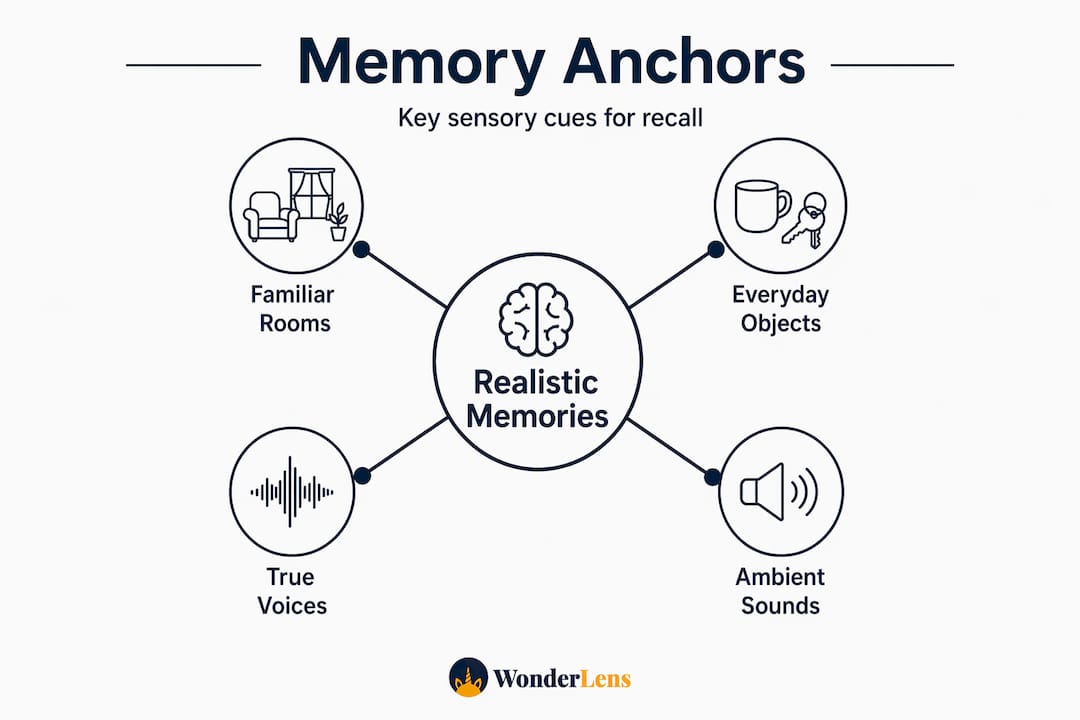
- The sound of a specific song playing during a holiday dinner acts as an auditory cue that pulls back the entire scene.
- The smell of a particular food tied to a family celebration can trigger recall of who was there, what was said, and how everyone felt.
- The layout of a room, which seats people chose, and even the quality of light through the window all serve as spatial cues that help both children and adults rebuild the memory.
- Familiar objects, like a worn tablecloth or a specific mug, function as physical anchors that reinforce memory retrieval across years.
Realistic family contexts such as familiar rooms, voices, and everyday objects help both children and adults retrieve and elaborate on memories far better than abstract or idealized settings. The family home is not just where life happens. It is the memory architecture your children will carry for decades.
Pro Tip: When capturing a family moment on video or photo, record a few seconds of the ambient sounds in the room. That background audio becomes a powerful retrieval cue years later when you replay it together.
Emotional salience and why feelings alone are not enough
Many parents assume that if a moment felt deeply emotional, the memory will automatically stick. The reality is more nuanced. Internal thoughts and feelings are more prone to forgetting than external, perceptual details, unless those feelings are anchored to concrete context. A moment that felt overwhelming with joy but lacked specific sensory or situational anchors may fade surprisingly fast.
What truly builds durable family memories is the combination of emotional intensity and informational richness. Here is how that works in practice:
- Emotional salience gets the encoding started. A moment that surprises, delights, or deeply moves your child captures heightened neurological attention. That attention opens the door for encoding.
- Perceptual detail fills in the structure. What the room looked like, what sounds were present, what you were all wearing, these external cues give the emotional experience somewhere to live in the brain.
- Novelty extends how long the memory persists. Event novelty and mental imagery richness both predict longer-lasting autobiographical memory. An experience that felt both meaningful and genuinely new is more likely to remain vivid over time.
- Contextual links prevent distortion. When emotional intensity is grounded in real-world details, the memory is less vulnerable to being rewritten or blurred by later experiences.
A 2026 study found that emotional intensity and contextual links actively protect against the forgetting and distortion of internal experiences in autobiographical memory narratives. For families, this is a meaningful finding. If you want your children to remember the feeling of a magical Christmas morning twenty years from now, the feeling alone will not be enough. The specific, real details of that morning are what make the emotion retrievable.
Pro Tip: Right after a big family moment, ask each person to share one specific thing they noticed with their senses. Not what they felt in general, but what they saw, heard, or smelled. This small practice reinforces the perceptual anchors that hold emotional memories in place.
Realistic storytelling and how it builds shared family memory
The way your family talks about its own history matters just as much as the moments themselves. This is where realism in family storytelling becomes a genuine skill. Stories that are vague or overly abstract tend to fade. Stories anchored in specific places, people, and sensory detail are shared and remembered consistently across the whole family.
Consider the difference between two ways of retelling the same moment:
| Vague retelling | Realistic retelling |
|---|---|
| "We had a really nice Christmas that year." | "We were all sitting on the living room floor, Mia in her red pajamas, and the tree lights were blinking because one strand had a short in it." |
| "The Easter egg hunt was fun." | "Jake found the golden egg behind the big plant pot on the back porch, and he screamed so loud the neighbors heard him." |
| "We used to do big family dinners." | "Gran always sat at the head of the table and kept her coffee mug on the left side, and she'd start every meal with the same joke." |
The realistic versions do not just describe what happened. They give the listener something to hold onto. That is why families who use concrete, place-based, sensory-rich language when retelling events end up with stronger shared family recall across generations.
Research supports focusing on 2 to 4 vivid anchors rather than trying to capture everything. Detailed retellings only improve memory when they reinstate the key encoding cues. Too many details without a coherent thread actually dilutes the effectiveness.
Here are the anchors worth choosing:
- A specific location within the scene, not just "the house" but "the corner of the den near the fireplace."
- One sensory detail that was unusual or striking, a smell, a texture, a sound.
- A specific thing someone said, word for word if possible.
- A moment of surprise or emotion that everyone experienced together.
Repeated retellings using these same consistent anchors consolidate the memory over time. Repeated reactivations soon after events improve later free recall, and the consistency of those cues is what keeps the memory stable rather than distorted.
Practical ways to build realism into everyday family moments
Knowing the science is one thing. Doing something with it is another. These strategies are all things your family can start using right now, without any special equipment or planning.
- Capture ambient details, not just highlights. The highlight reel of a birthday party is wonderful, but a recording of everyone singing off-key or the sound of wrapping paper crinkling creates richer retrieval cues than the posed photo alone.
- Encourage specific sharing at the dinner table. Instead of "How was your day?" try asking, "Tell me one thing you noticed today." Specificity in daily conversation builds the habit of realistic memory encoding.
- Retell stories soon after events. Memory reconsolidation via repeated retelling strengthens recall, but it requires consistent, embodied cues to prevent the story from drifting over time. Do this together as a family in the days after a meaningful event.
- Use familiar objects as memory prompts. Keep a few items from significant family events in visible places. A small ornament from a trip, a photo tucked into the kitchen corkboard, these act as passive retrieval cues every time someone sees them.
- Let the setting do the work. Memory recall is richer in real-world, everyday settings than in abstract or artificial ones. Revisiting the actual places where meaningful moments happened, or recreating those settings digitally, helps both children and adults access deeper memory detail.
When it comes to digital tools, the importance of realism in memory preservation cannot be overstated. A generic filter or cartoon sticker overlay does not add meaningful retrieval cues. What creates lasting impact is coherent narrative realism, where the characters, lighting, and environment feel genuinely connected to the actual family space. You can explore more ideas in this guide on creating digital memories that feel real and personal for kids.
Pro Tip: After a holiday or special occasion, sit down as a family and write three specific sensory details about the day on a slip of paper. Put it in a jar. Reading it aloud a year later will unlock memories with surprising clarity.
My honest take on realism and family memory
I used to think the goal of any family memory was to make everything look beautiful. The perfectly decorated table, the kids in matching outfits, the moment captured in golden light. What I have learned, both from watching families and from my own experience, is that those polished moments often feel oddly thin when you look back on them.
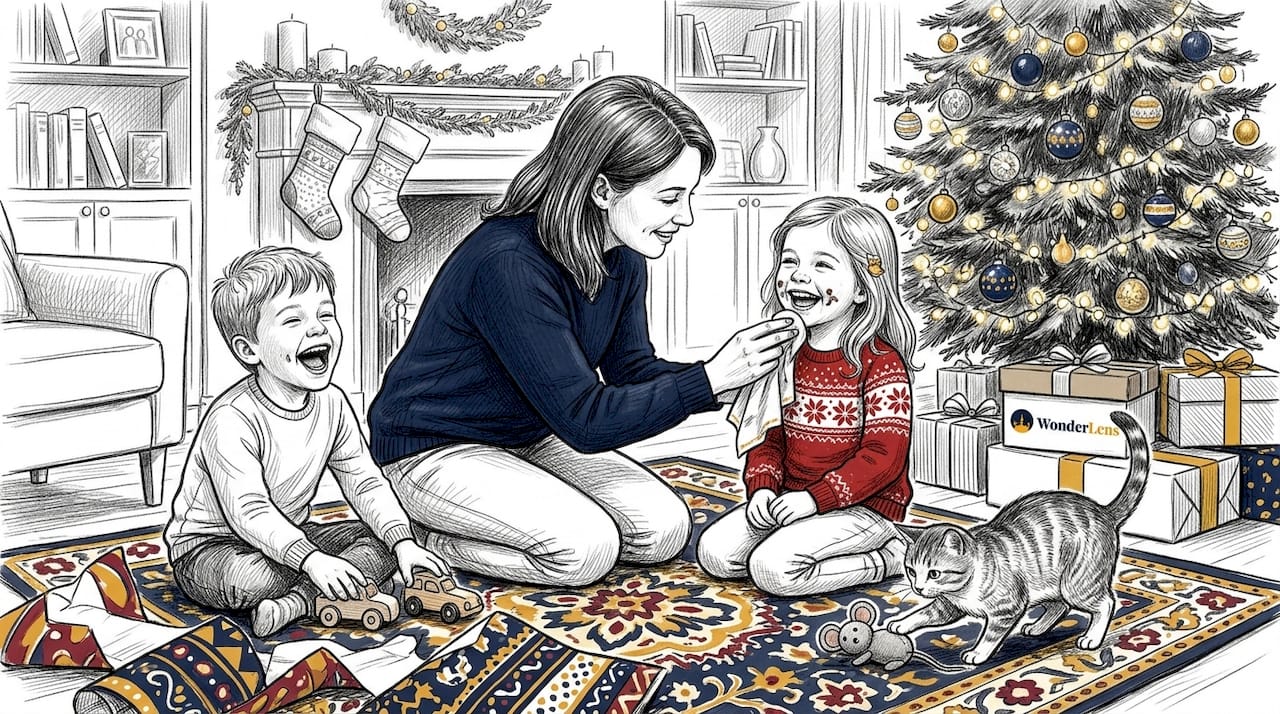
The memories that genuinely moved me were never the pristine ones. They were the ones with texture. The year the Christmas tree fell over. The Easter morning my youngest got distracted by a caterpillar and forgot to collect half her eggs. The dinner where the soup boiled over and everyone laughed until they cried. These moments were not perfect. They were real. And they stuck.
What I have found is that when you stop chasing the idealized version of a family moment and start paying attention to the specific, honest details in front of you, something shifts. The stories become easier to tell. The kids remember them longer. And the emotional connection in the retelling feels genuine because it is.
I think the magic in family memories does not live in the highlight reel. It lives in the specific, imperfect, real details that only your family could have. That is where the bond actually forms. That is what your children will carry with them.
— Jeremiha
Bring your family's real moments to magical life with Wonderlens

Wonderlens was built on exactly this principle: that the most powerful memories feel real. When Santa walks through your actual living room, casting shadows on your real furniture and catching the same golden glow from your lamp, your child's brain does not just see a character. It sees a moment that belongs to your home and your family. That specificity is what makes it memorable.
Using AI-driven lighting, shadow casting, and movement, Wonderlens places cinematic animated characters directly into your family's real environment. No generic backgrounds. No obvious overlays. Just a 10-second magical video that feels like it actually happened in your space. Starting at just $1.99, it is one of the simplest ways to add a genuinely realistic, wonder-filled moment to your family's memory collection. You can also find fresh ideas for animated memories with your kids to make every special occasion feel truly personal.
FAQ
Why does realism make memories stronger?
Realism provides sensory and environmental cues that match the original encoding context, making memories far easier to retrieve. Research on cue-dependent forgetting shows that mismatched cues are a primary cause of memory failure.
How does emotional intensity affect family memory?
Emotional intensity improves initial encoding, but without concrete contextual details it is highly vulnerable to forgetting or distortion. Studies show that linking emotion to external cues is what stabilizes memories over time.
How many details should we include when retelling family stories?
Focus on 2 to 4 vivid, specific anchors rather than trying to cover everything. Matching context cues at recall is what matters, and focusing on key anchors is more effective than exhaustive detail.
Can digital videos help preserve family memories realistically?
Yes, when the visual and narrative cues are coherent and tied to the actual family environment. Embodied narrative realism produces stronger associative memory binding than purely decorative or abstract visual effects.
When is the best time to retell a family memory?
Retelling a memory soon after the event produces the strongest consolidation. Repeated early reactivations improve long-term recall, especially when you use consistent, specific cues each time you revisit the story.
Recommended
- Why create magical memories? Real value for your family — WonderLens | WonderLens
- Why Use Video over Photo Editing for Memories — WonderLens | WonderLens
- Why integrating fantasy into home photos creates magic — WonderLens | WonderLens
- Why Magical Videos Make Holiday Memories Last for Children — WonderLens | WonderLens