Realistic Visual Effects Explained for Filmmakers
May 18, 2026
Most people assume that what is realistic visual effects comes down to making things look like a perfect photograph. That idea sounds right, but it misses the actual magic. Truly convincing VFX is not a copy of reality. It is a deliberate construction of light, material, motion, and emotion that tricks the human brain into believing what it sees. Whether you are a filmmaker, a content creator, or a hobbyist experimenting at home, understanding how this works changes everything about how you approach your projects.
Table of Contents
- Key takeaways
- What is realistic visual effects, really
- Core technical elements of realistic VFX
- The art behind the science
- Creating realistic fire and explosion effects
- Practical workflow for creators and filmmakers
- My take on realism and storytelling in VFX
- Bring your own magical effects to life with Wonderlens
- FAQ
Key takeaways
| Point | Details |
|---|---|
| Realism is art plus science | Convincing VFX requires matching lighting, materials, and motion while serving the story. |
| Lighting accuracy is non-negotiable | Shadow direction, color temperature, and light quality must match the live footage exactly. |
| Artistic nudges outperform pure accuracy | Slightly exaggerated detail creates more emotional impact than a sterile, photographic copy. |
| Fire and explosions demand simulation depth | Vorticity confinement and blackbody radiation produce the turbulent organic motion audiences expect. |
| Workflow discipline saves render time | Systematic asset breakdowns, HDRI capture, and pipeline automation prevent costly iteration failures. |
What is realistic visual effects, really
Realistic visual effects are the craft of generating or enhancing imagery so convincingly that viewers accept it as part of the real world they are watching. That covers everything from a single floating dragon in a living room to a city-scale destruction sequence in a blockbuster film.
The word "realistic" does not mean photographically perfect. It means perceptually believable. Your eye and brain have deeply wired expectations about how light behaves on surfaces, how smoke curls and disperses, how a creature's weight shifts when it moves. When those expectations are met, you believe what you see. When they are violated even slightly, something feels wrong, even if you cannot name it.
There is a useful distinction between special effects and VFX worth understanding here. What are special effects traditionally refers to physical, on-set techniques like pyrotechnics, animatronics, and practical makeup. Visual effects, on the other hand, are created or enhanced in post-production using digital tools. The most convincing results almost always combine both.
The importance of realistic VFX extends beyond blockbuster budgets. It shapes how audiences connect emotionally with stories, how families create magical memories at home, and how independent creators punch far above their production weight.
Core technical elements of realistic VFX
Understanding visual effects at a technical level starts with three foundational pillars: lighting, materials, and integration. Get these right, and almost everything else falls into place.
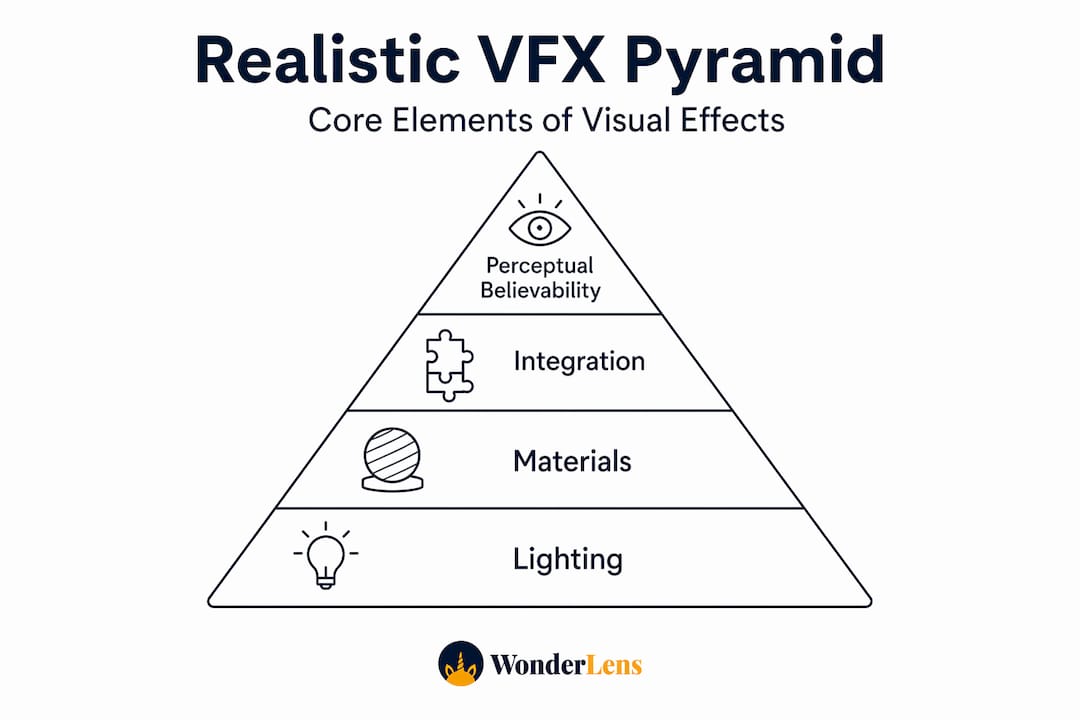
Lighting: the single most important factor
Light is the thing your eye trusts most. If a CGI element is lit from the wrong direction, casts no shadow, or has the wrong color temperature, it reads as fake immediately. Realistic visual effects techniques rely on:
- HDRI and image-based lighting (IBL): Capturing a 360-degree photograph of the real set or environment and using it to illuminate your CG elements. This means the dragon in your living room is lit by the actual light in your room, not a generic studio setup.
- Ray tracing: Simulating how light physically bounces between surfaces. It produces accurate reflections, soft shadows, and subtle color bleed that sell depth.
- Shadow matching: Your CG shadow must fall in exactly the direction and softness of existing shadows in the shot. A single misaligned shadow breaks the illusion completely.
Physically based rendering and materials
Physically based rendering, or PBR, builds material properties from real-world measurements. A wet stone scatters light differently from dry concrete. Skin absorbs and re-emits light through subsurface scattering, giving it that warm, slightly translucent glow. When you skip PBR and hand-paint materials by eye, surfaces look plastic or oddly lit under any light except the one you designed them for.
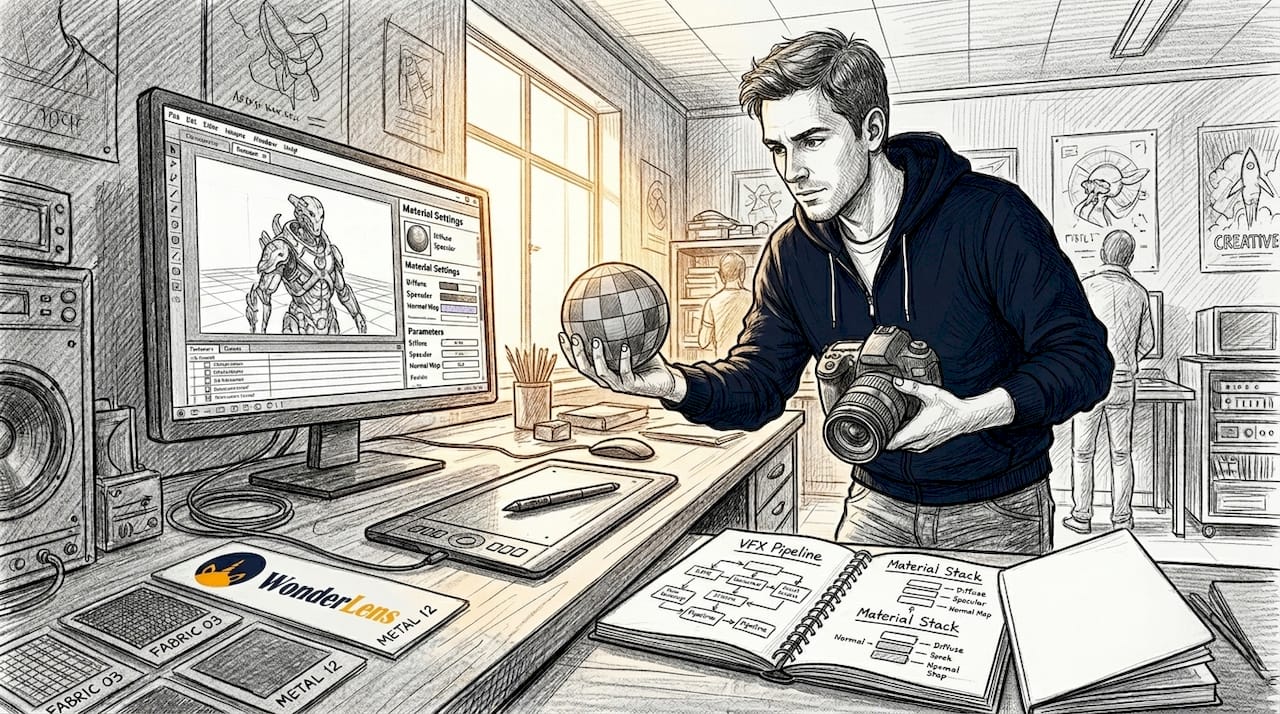
Photogrammetry takes this further by scanning real-world objects with overlapping photographs and reconstructing their exact geometry and surface texture as a 3D asset. A rock scanned from your backyard carries the exact micro-detail that makes it visually indistinguishable from the real thing. For on-set reference environments, newer technology like Gaussian Splatting renders scenes at over 100 frames per second on consumer GPUs, letting you preview CG integration in near-real-time.
Pro Tip: Shoot a chrome ball and a gray ball on set before filming. These simple reference tools capture the exact direction, intensity, and color of every light source in your scene and give your compositor everything they need to match CG lighting precisely.
Integration and compositing
Even a technically perfect CG element fails if it is not composited properly into the footage. Color grading, grain matching, lens aberration, and depth of field all need to match the camera characteristics of your shoot. Compositing integration failures for fire effects, for example, most commonly include missing environmental illumination, absent heat haze, and no smoke interaction with surrounding objects.
The art behind the science
Here is something most technical breakdowns skip: digital realism blends classical art principles with modern simulation. Pure accuracy can actually feel sterile. A photograph of a real fire sometimes looks less dramatic than a well-crafted VFX fire because the simulation allows the artist to emphasize the most visually compelling aspects of flame behavior.
The artistic principles that elevate realistic VFX include:
- Form and silhouette: A creature's outline must read clearly at the sizes and distances it appears on screen.
- Contrast and focal guidance: You can nudge light and shadow to guide the viewer's eye toward story-relevant details.
- Timing and weight: In animation, the way something accelerates and decelerates tells us how heavy it is. A dragon landing must feel like tons of muscle hitting the ground.
"The goal is not to fool the eye. It is to move the heart. Realism is the vehicle, not the destination." — The Craft of Making Virtual Worlds Feel True
This is why the best visual effects in filmmaking feel emotionally satisfying, not just technically impressive. A T-Rex that moves with predatory weight feels terrifying. A T-Rex that moves with anatomically correct but uninflected accuracy just feels like a museum exhibit.
Selective exaggeration is a tool, not a compromise. Slightly oversaturated fire, slightly thicker smoke trails, a touch more rim lighting on a creature's edge. Each nudge makes the VFX read better at the size and context of how audiences actually consume the image.
Creating realistic fire and explosion effects
Fire and explosions are among the hardest things to fake in VFX. They are also among the most scrutinized, because every viewer has seen real fire and their brain has strong expectations.
Here is how professionals approach it:
- Run a fluid dynamics simulation. Fire is essentially hot gas moving through a density gradient. Simulation software models this as voxel-based volumes with temperature, density, and velocity fields. The simulation generates the raw shape and motion of the flame.
- Apply vorticity confinement. This is a critical step. Vorticity confinement adds turbulent detail to the flame edges, creating the chaotic, organic motion that real fire has. Skip it and you get smooth, laminar flames that look like a screen saver.
- Use blackbody radiation for color. Real fire color is tied to temperature. The hottest core is blue-white, mid-range is orange, and cooler edges are deep red. Blackbody radiation models give you physically accurate color gradients automatically.
- Simulate the explosion shockwave. For explosions, shockwaves are modeled as fast-expanding refractive volumes that distort the air and surrounding smoke. True supersonic gas dynamics are too computationally expensive to simulate accurately, so VFX artists use clever approximations that produce the same perceptual result.
- Composite with environmental interaction. The fire must cast light onto surrounding surfaces in real time. Actors near an explosion should be illuminated by a flickering orange-red light. Without this, the fire floats on top of the scene like a sticker.
Pro Tip: Always render your fire simulation in linear light, not gamma-corrected. Compositing fire in the wrong color space is one of the most common reasons CG fire looks fake even when the simulation itself is excellent.
For context on how demanding this gets at the professional level, Avatar: Fire and Ash used 1.2 billion render hours, the equivalent of roughly 142,000 years of nonstop computation. Your laptop render farm has limits. Plan your simulations accordingly.
Practical workflow for creators and filmmakers
Knowing what realistic visual effects require is one thing. Building a practical workflow to actually produce them is another. Here is how to approach it systematically.
- Break down your environment before you shoot. Identify every lighting source, surface material, and depth layer in your scene. Document them. Photorealistic VFX environments require systematic asset breakdown, HDRI capture, and organized layering from the ground up.
- Capture lighting references on set. Shoot an HDRI panorama and reference spheres at every major camera position. Do it before the actors arrive, while the lighting is clean. This one habit saves dozens of hours in post.
- Get the VFX team and the cinematographer talking. The best modern VFX results come from collaboration between lighting artists and cinematographers, not from each working in isolation. The DP should know what the VFX supervisor needs; the VFX supervisor should understand the lens and camera choices being made.
- Layer effects progressively. Start with background elements, then mid-ground, then foreground. Match color and grain at each layer before moving to the next. This prevents compounding errors that are expensive to fix later.
- Blend practical with digital. Practical effects interact naturally with on-set lighting and give actors something real to react to. Using a small practical fire element on set and extending it digitally almost always beats a purely digital fire.
The table below shows how different approaches compare for common VFX scenarios:
| Scenario | Recommended approach | Key challenge |
|---|---|---|
| Creature in interior scene | Practical stand-in plus CG replacement | Lighting match and shadow accuracy |
| Fire and explosion | Practical element plus fluid simulation | Environmental illumination and heat haze |
| Environment extension | Photogrammetry plus matte painting | Perspective and focal length consistency |
| Fantasy character at home | AI-driven rendering with HDRI lighting | Shadow casting and material interaction |
One more thing worth knowing: pipeline issues cause more production loss than aesthetic choices do. Inconsistent simulation seeds, misnamed asset versions, and broken render farm jobs are responsible for more failed projects than bad artistry. Automated pipeline strategies that use deep learning composites reviewed overnight reduce these bottlenecks significantly by producing multiple iteration passes for quick review without waiting for full renders.
My take on realism and storytelling in VFX
I have spent years watching VFX projects succeed and fail, and the pattern is not what most beginners expect. The projects that look best are almost never the ones that chased technical perfection the hardest. They are the ones where the artist knew why they wanted something to look real.
When I see a creator agonize over sub-pixel shadow softness on a creature that only appears for three seconds, I know they have lost the plot. Realism earns its keep when it serves the emotional truth of the scene. A softly glowing fairy in a child's bedroom does not need physically accurate subsurface scattering. It needs the right color warmth and a shadow that falls convincingly on the floor. That is enough. The child believes it because the emotional context is right.
What I find genuinely exciting about today's tools is that they put decisions about realism in the hands of people who care about stories, not just studios with unlimited budgets. Platforms built around AI-driven rendering are doing something studios spent millions of dollars figuring out, and they are putting it in the reach of anyone with a phone and a creative idea.
My honest advice: learn the rules of lighting and materials well enough to break them intentionally. Push shadow contrast a little. Let the creature's eyes catch a highlight that is not quite where it should be. That is where magic lives.
— Jeremiha
Bring your own magical effects to life with Wonderlens
You now understand the principles that make visual effects feel real. Wonderlens puts those same principles to work for you, without the need for a render farm or a VFX team.

Wonderlens uses advanced AI-driven rendering to place animated fantasy characters like Santa, dragons, and fairies directly into photos of your home, complete with accurate shadow casting, matched lighting, and natural movement. The result is a shareable 10-second video that looks like your living room was always part of the magic. Starting at just $1.99 per video, create magical memories for your family today. No technical skill required. Just a photo and a little wonder.
FAQ
What is the difference between VFX and special effects?
Special effects are created physically on set using pyrotechnics, animatronics, or practical props. VFX are created or enhanced digitally in post-production, and the best results typically combine both approaches.
Why do some CGI effects look fake even with high budgets?
Most CGI failures come down to lighting mismatch, wrong shadow behavior, or compositing errors rather than geometry or texture quality. Even a technically detailed model reads as fake if it is lit differently from the rest of the scene.
How do filmmakers create realistic fire with visual effects?
Realistic fire relies on fluid dynamics simulations enhanced with vorticity confinement for turbulent motion and blackbody radiation for accurate color. The fire must also illuminate surrounding surfaces and interact with smoke to feel fully integrated.
Can hobbyists and small creators achieve realistic VFX?
Yes. Tools like HDRI lighting capture, photogrammetry apps, and AI-driven rendering platforms have made high-quality realistic effects accessible without studio-level budgets or team sizes.
What is the most common mistake in realistic VFX?
Poor lighting match between the CG element and the live footage is the single most common failure. Shooting HDRI reference and chrome ball captures on set before filming is the most reliable way to prevent it.
Recommended
- What is visual realism in home videos? Make magic feel real — WonderLens | WonderLens
- What realism in digital media means for holiday magic — WonderLens | WonderLens
- How to create magical videos kids will truly love — WonderLens | WonderLens
- Santa video rendering: How AI creates holiday magic — WonderLens | WonderLens