The Role of AI in Digital Keepsakes Explained
May 28, 2026
The photos sitting in your phone's camera roll are not a memory archive. They are a pile. The role of AI in digital keepsakes goes far beyond organizing that pile into something tidy. Today, AI shapes which moments feel meaningful, gives voice to people no longer with us, and generates cinematic tributes from a handful of snapshots. What started as smart tagging and album sorting has grown into something much more personal, and much more powerful. This guide covers how AI curates, creates, and complicates the way families preserve the moments that matter most.
Table of Contents
- Key Takeaways
- The role of AI in digital keepsakes and memory curation
- Interactive AI keepsakes: voice, personality, and legacy agents
- Creating AI-generated memory videos and visual storytelling
- Ethical, privacy, and legal considerations
- How to create meaningful AI-enhanced keepsakes
- My honest take on trusting AI with your memories
- Create magical AI keepsakes with Wonderlens
- FAQ
Key Takeaways
| Point | Details |
|---|---|
| AI shapes personal narratives | Automated curation selects which memories get surfaced, which means you need to stay in control of those choices. |
| Interactive legacy agents go beyond static storage | AI can model personality and voice to create conversational keepsakes families can engage with over time. |
| Prompt quality drives video output | For AI-generated tribute videos, the detail in your text prompts directly determines how lifelike the result feels. |
| Consent documents protect your legacy | Legal frameworks for AI use of your likeness and voice must be set up during your lifetime, not after. |
| Ethical design requires transparency | Reliable platforms separate AI-generated content from verified memories and give users override controls. |
The role of AI in digital keepsakes and memory curation
Most people assume their photo app simply stores pictures. The reality is more interesting, and more consequential. Modern AI photo systems scan your entire library, recognize faces, detect locations, identify emotional expressions, and group images into what they decide are your most meaningful moments. That "Year in Review" video your phone assembled? An algorithm made every creative choice in it.
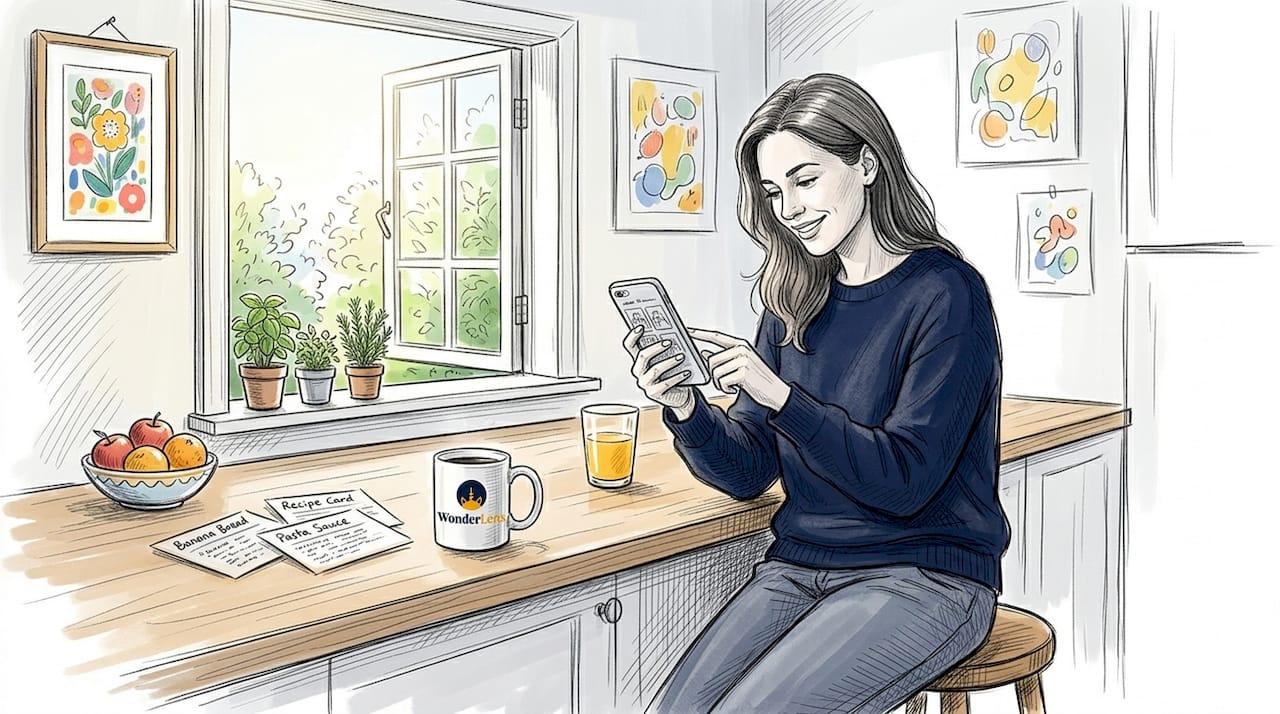
According to researchers studying algorithmic authorship, AI curation teams view their tools as surfacing memories rather than determining them. But that distinction matters less than it sounds. When AI selects which ten photos represent your year, it is writing a version of your story. If it consistently surfaces your child's first steps but never your quiet Sunday mornings, it shapes how you remember that time.
The risks go deeper than aesthetics. AI misclassification can resurface painful memories at the wrong moment, or bury significant ones because they were low-resolution or poorly lit. Bias in training data means AI tools may handle certain faces, cultural celebrations, or family structures differently than others. These are real gaps that affect real families.
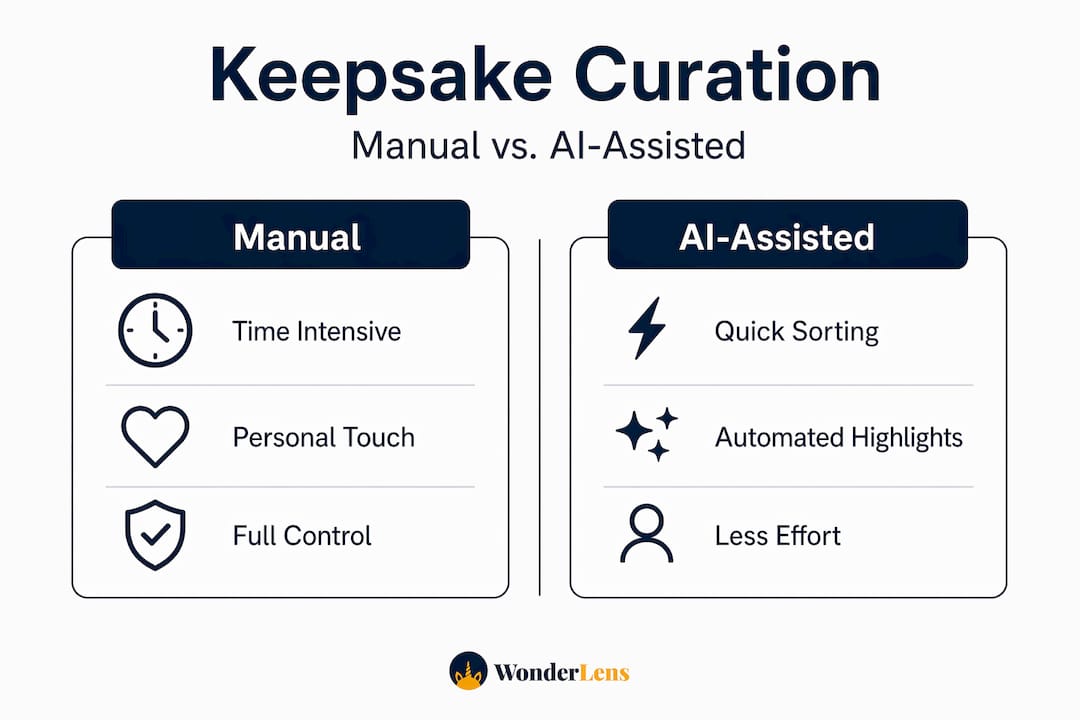
Here is a comparison of how manual and AI-curated keepsake creation actually differ in practice:
| Factor | Manual curation | AI-assisted curation |
|---|---|---|
| Time investment | High | Low |
| Personal context | Full | Limited |
| Emotional accuracy | High | Variable |
| Bias risk | Low | Moderate to high |
| Scalability | Limited | Strong |
| User control | Complete | Depends on platform |
Pro Tip: Before letting any AI platform generate a highlights reel or tribute video, manually select 10 to 15 "anchor" photos first. Anchoring your selections before automation kicks in helps preserve the narrative you actually want to tell.
Interactive AI keepsakes: voice, personality, and legacy agents
Static photos and video clips are one kind of memory. But what if you could ask your grandfather a question and hear his voice respond? That is not science fiction anymore. It describes the emerging field of AI digital legacy agents, which are conversational systems trained on a person's messages, recordings, documents, and behavioral patterns to create an interactive representation of them.
The most sophisticated systems use what developers call a layered memory architecture. Anchor memories form the core of the AI personality, capturing core values, key relationships, and formative experiences that keep the conversational agent consistent over time. Family members can then interact with the agent, ask questions about shared memories, or simply hear familiar stories retold.
Voice preservation is a separate but related tool. Some platforms focus specifically on capturing and replicating acoustic characteristics: tone, cadence, regional inflection, the way someone laughs before they finish a sentence. The design philosophy behind responsible voice preservation tools is constraint. A well-designed voice tool replicates only what the person actually said, never inventing new responses or fabricating opinions they never expressed.
Here is what makes interactive AI keepsakes genuinely different from static digital mementos with AI:
- They respond. You can ask a question and receive a reply drawn from real recorded content.
- They evolve. Family members can add new memories or stories over time, keeping the experience current.
- They are accessible anywhere. A grandchild in another state can connect with a preserved voice without needing a physical object.
- They require boundaries. The best platforms make it transparent when content is reconstructed versus directly recorded.
Pro Tip: When setting up any interactive AI keepsake, record dedicated "anchor" voice samples covering different emotional registers: storytelling, laughter, giving advice, and quiet reflection. These give the AI richer material to draw from than phone call recordings alone.
Creating AI-generated memory videos and visual storytelling
One of the most striking applications of AI for memory preservation is text-to-video generation for personal tributes. A man in the Philippines went viral after using AI to recreate his mother's memories in a birthday film, generating scenes she described in stories but that were never photographed. The result moved viewers because it felt cinematic and specific, not generic.
The quality of that output depends almost entirely on the prompt. Vague inputs produce generic scenes. Detailed inputs produce something that feels personal. If you want AI to recreate a childhood kitchen, describing "a small yellow kitchen with a linoleum floor, a red kettle on the stove, and afternoon light through a west-facing window" produces something recognizable. "A kitchen from the 1970s" does not.
Here is a practical step-by-step process for creating an AI-generated memory video:
- Gather source material. Collect photos, written descriptions, recorded voice notes, and any existing video clips of the person or place you want to recreate.
- Write detailed scene prompts. For each moment you want to visualize, write 3 to 5 sentences describing setting, lighting, emotional tone, and specific sensory details.
- Choose your AI video platform carefully. Look for tools that let you upload reference images to anchor the visual output to actual people and places.
- Generate and review. Create first drafts and review them with family members who knew the person or place well, checking for accuracy.
- Label clearly. Any AI-generated content should be explicitly identified as reconstructed, not photographic.
That last step matters more than it seems. Experts are clear that transparency in AI-generated content is non-negotiable for maintaining trust with your audience, whether that audience is your immediate family or a broader community.
Pro Tip: Keep your original source materials permanently separate from AI-generated recreations. Store them in different folders with clear labels. Future generations deserve to know which moments were photographed and which were imagined.
Ethical, privacy, and legal considerations
The impact of AI on keepsakes is not purely positive. The most significant risk is one that feels abstract until it happens to you. MIT Media Lab researchers warn that AI-generated reconstructions can implant false memories, meaning people begin to genuinely misremember events based on AI-created visuals they have seen enough times. A beautifully rendered scene of a grandparent's childhood home, generated from a single description, can become what you "remember" seeing, even if it was never real.
Legal consent is the other pressure point. If you want AI to use your voice or likeness after your death, those permissions must be documented during your lifetime. Legal experts recommend that consent documents specify exactly who can use your likeness, for what purposes, on which platforms, and how that permission can be revoked. A general "do what you want" clause is not sufficient and may not hold up.
Here is a practical reference for the key ethical considerations any family should work through:
| Area | Risk | Best practice |
|---|---|---|
| Memory accuracy | AI-generated content creates false memories | Label all AI reconstructions clearly and separately |
| Voice and likeness | Unauthorized posthumous use | Document explicit, revocable consent during lifetime |
| Data security | Personal content stored on third-party servers | Use platforms with clear data deletion and access policies |
| Emotional sensitivity | Unexpected resurfacing of painful memories | Review AI-curated content before sharing with family |
| Bias | AI may underrepresent certain people or moments | Manually review and supplement all automated selections |
Pro Tip: Treat consent as a living document. Review and update it whenever you add new content to a digital legacy platform, just as you would review a will after a major life event.
How to create meaningful AI-enhanced keepsakes
Knowing what AI can do is different from knowing how to use it well. The families who get the most out of AI in personalized keepsakes are not the ones who hand everything over to automation. They are the ones who treat AI as a collaborator rather than a replacement for their own judgment.
A few practices that consistently produce better results:
- Start with intention. Before opening any platform, decide what story you want this keepsake to tell. A tribute to someone's work ethic needs different source material than a tribute to their sense of humor.
- Mix automation with manual choices. Let AI surface options, then make the final selections yourself. The best keepsakes combine AI's ability to process large libraries with your knowledge of context and meaning.
- Set clear boundaries for AI creativity. If you are using a generative tool, decide in advance what it is allowed to invent versus what must be based on real documentation.
- Include other voices. Gather written or recorded memories from multiple family members before feeding content into AI tools. The richer the input, the more accurate the output.
- Plan for the future. The most thoughtful digital family memories are built to be updated. Leave room for new stories to be added as children grow and memories accumulate.
The future of digital memorabilia is not one where AI does everything. It is one where AI does the heavy lifting so you can focus on the meaning.
My honest take on trusting AI with your memories
I have spent a lot of time thinking about where AI genuinely helps families and where it quietly takes over in ways they do not notice. My honest view is this: AI is extraordinary at scale and terrible at significance. It can process 10,000 photos in minutes and identify your most-photographed smile. It cannot tell you that the blurry, poorly lit snapshot from a Tuesday night dinner was the last photo taken before everything changed.
What I have learned is that the people who feel most satisfied with their AI-assisted keepsakes are the ones who never stopped being the editor. They use AI to find raw material, then they curate. They use AI to generate a scene, then they correct it. They treat every automated output as a first draft, not a finished product.
The platforms I trust most are the ones that make AI's editorial choices visible and reversible. If a platform does not let you override its selections, or does not label generated content as generated, that is a design choice worth questioning. Memory is too personal to outsource entirely.
The emotional weight of preserving someone's voice, recreating a childhood scene, or choosing which ten photos represent a year of your life deserves your attention. Use the tools. Just stay in the room.
— Jeremiha
Create magical AI keepsakes with Wonderlens
If you are ready to see how AI transforms a simple family photo into something your kids will talk about for years, Wonderlens is worth exploring. The platform places cinematic-quality animated characters, from Santa to fairies to dragons, directly into your home environment. The AI renders accurate shadows, realistic lighting, and natural movement so the scene looks like it genuinely happened in your living room.
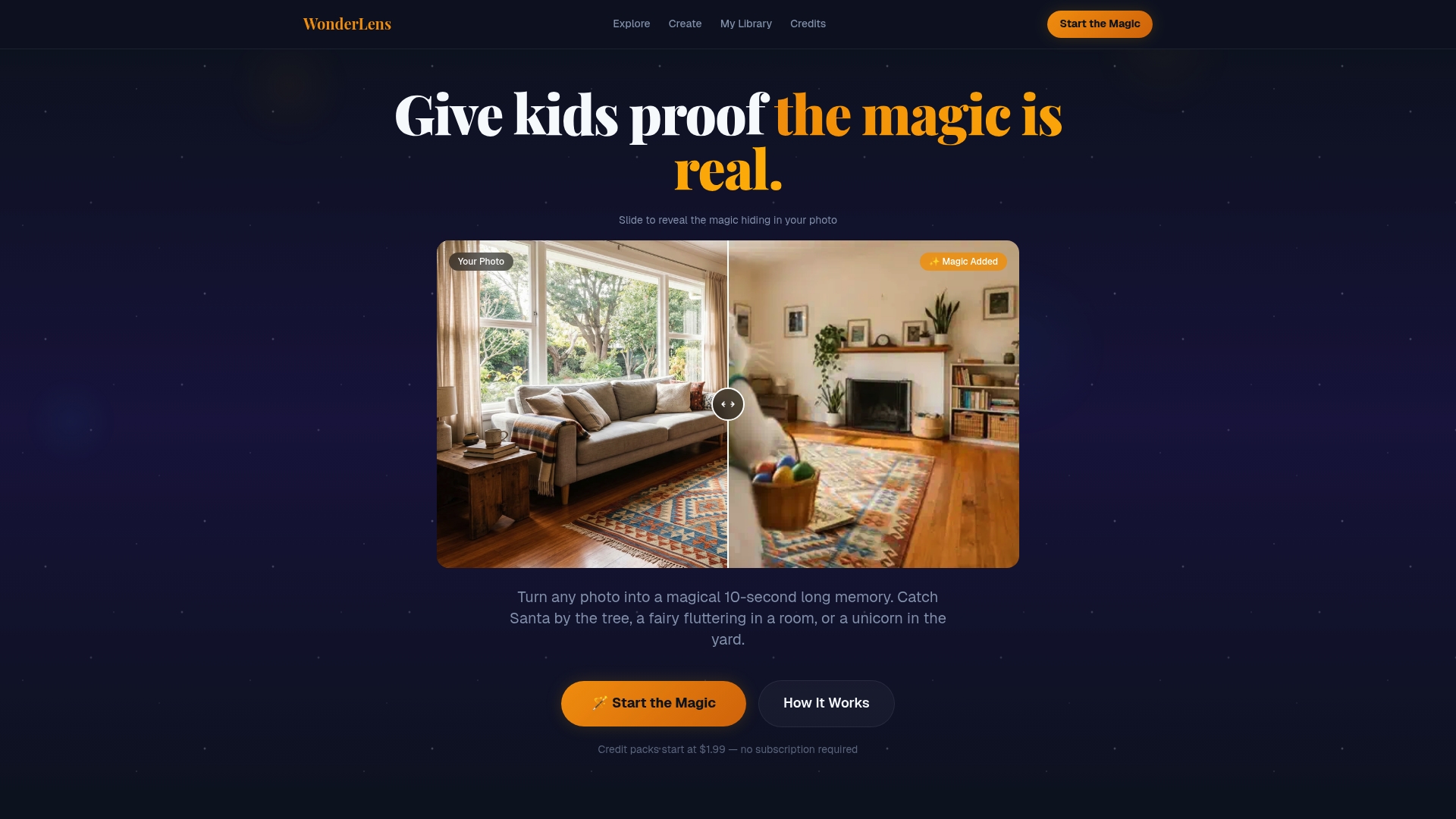
Wonderlens is designed to be simple, family-friendly, and genuinely magical. You upload a photo, choose your character, and receive a 10-second video that captures real holiday wonder. It is a beautiful example of how AI-powered photo animation can create personalized digital keepsakes that feel real, not like a filter. Credits start at $1.99, making it an accessible way to turn an ordinary evening into an extraordinary memory. Visit Wonderlens to start creating yours.
FAQ
What is the role of AI in digital keepsakes?
AI curates, personalizes, and generates digital keepsakes by selecting meaningful moments from large photo and video libraries, enabling interactive voice-based legacy agents, and producing cinematic tribute videos from text descriptions. The technology shapes how memories are preserved and experienced by families over time.
Can AI accurately preserve someone's voice and personality?
Yes, with important limitations. AI voice preservation tools can replicate acoustic characteristics with high fidelity, but responsible platforms only reproduce what the person actually said and avoid inventing new responses beyond the original recorded content.
How do you prevent AI from creating false memories in keepsakes?
Clearly label all AI-generated content as reconstructed rather than photographic, and keep original source materials in a separate, clearly identified archive. MIT research confirms that repeated exposure to AI-generated visuals can distort genuine recollection over time.
Do you need legal consent for AI to use someone's likeness?
Yes. Legal experts recommend documenting explicit consent during a person's lifetime, specifying which platforms, uses, and audiences are permitted. The consent document should also include a clear revocation mechanism that family members can enforce.
How does Wonderlens use AI for personalized keepsakes?
Wonderlens uses AI-driven visual rendering to place animated fantasy and holiday characters into real home environments using a single photo. The platform generates short, shareable videos with accurate lighting and shadow rendering, creating personalized digital mementos that families can revisit and share.
Recommended
- AI Christmas Videos: Create Magical Holiday Memories Fast — WonderLens | WonderLens
- AI-powered photo animation: create magical family memories — WonderLens | WonderLens
- Creative photo animation steps for magical family memories — WonderLens | WonderLens
- What makes a digital experience truly memorable for families? — WonderLens | WonderLens