What Is Visual Realism in AI Videos for Filmmakers
May 26, 2026
If you've ever watched an AI-generated video and felt something was slightly off, you've already encountered the core challenge of what is visual realism in AI videos. It's not about pixel count or render quality alone. It's about whether a scene feels true, whether light behaves the way your brain expects, whether motion carries the right weight, and whether the story holds together frame to frame. For content creators and filmmakers, understanding this distinction is what separates work that looks generated from work that looks shot.
Table of Contents
- Key takeaways
- Technical foundations of visual realism in AI videos
- Cinematic realism and the power of felt coherence
- Common pitfalls that break AI video realism
- Applying visual realism to your storytelling workflow
- My take on where AI visual realism is actually heading
- See visual realism in action with Wonderlens
- FAQ
Key takeaways
| Point | Details |
|---|---|
| Realism goes beyond resolution | Visual fidelity in AI content requires temporal consistency, physics accuracy, and micro-details, not just sharp images. |
| Imperfections build trust | Controlled flaws like camera shake and grain are authenticity signals that make AI videos feel genuinely captured. |
| Cinematic truth beats photographic truth | Emotional plausibility and narrative coherence matter more than optical perfection for storytelling impact. |
| Reasoning models are replacing pattern models | AI tools that simulate physical logic maintain character identity and scene continuity across multi-shot sequences. |
| Prompting precision changes everything | Specifying hardware conditions and environmental details in your prompts produces far more convincing results. |
Technical foundations of visual realism in AI videos
Early AI video tools worked frame by frame, predicting each image independently. The results were visually striking in isolation but fell apart in motion. A character's jacket changed color between cuts. A shadow moved the wrong direction. Water splashed without obeying gravity. These are the artifacts of systems built for appearance, not for understanding.
Modern models approach this differently. Modern AI video models now use a latent representation of entire sequences, maintaining scene coherence across every frame rather than stitching together isolated predictions. That architectural shift alone explains why recent AI video looks so much more convincing than outputs from just two years ago.
The technical pillars driving this shift include:
- Spatiotemporal attention: Models that apply 3D attention across both space and time can track how an object moves through a scene, maintaining consistent texture, lighting, and position as it travels.
- Implicit physics priors: These are learned rules about how the world behaves. Water flows downward. Cloth folds under gravity. Shadows fall opposite light sources. Models like Google Veo and Kling build motion interpolation and environmental consistency directly into their architectures.
- High-quality training data: Models trained on professional 4K footage and labeled physical conditions outperform those trained on low-resolution internet clips. The quality of what a model learns from determines the ceiling of what it can produce.
- Micro-detail simulation: Lens distortion, chromatic aberration, film grain, and subtle camera shake are not flaws to be avoided. They are the statistical fingerprints of real-world capture, and models that reproduce them accurately read as more believable.
The newest generation of tools goes even further. Reasoning-native models maintain character identity, physical coherence, and causal narrative continuity across clips by reasoning about what should happen next, not just what looks similar.
Pro Tip: When evaluating an AI video tool, test it on a scene with a moving object interacting with a surface. Pour water onto a table. Drop a ball. If the physics collapse, the model lacks the reasoning architecture you need for serious production work.
Cinematic realism and the power of felt coherence
Here is where understanding visual realism in AI gets genuinely interesting. Photographic fidelity and cinematic realism are not the same thing. A video can be optically flawless and still feel hollow. Conversely, a slightly grainy, imperfect image can carry tremendous emotional weight.
AI cinematic realism frames this distinction precisely. Realism splits into three layers: perceptual fidelity (does it look right?), environmental realism (does the world behave consistently?), and authorial realism (does it feel intentional and true?). Most creators focus only on the first. The most compelling AI video work addresses all three.
"Cinematic realism is an affective, narrative event rather than purely photographic." This framing, drawn from research on synthetic images, should change how you evaluate AI video tools entirely.
What this means in practice:
- Emotional plausibility: A character's movement should match the emotional weight of the scene. Fear moves differently than joy. AI models that ignore this produce motion that feels disconnected from the story.
- Atmospheric continuity: The color temperature of a scene, the haze in the air, the way light wraps around objects. These need to stay consistent across a sequence or the eye catches the lie immediately.
- Spatial coherence: Objects need to occupy real positions in a real space. Depth relationships between foreground and background should hold across cuts.
- Character interiority: Even in a 10-second clip, viewers read intent and emotion into a character's posture and gaze. AI video that gets this right creates a strong sense of presence.
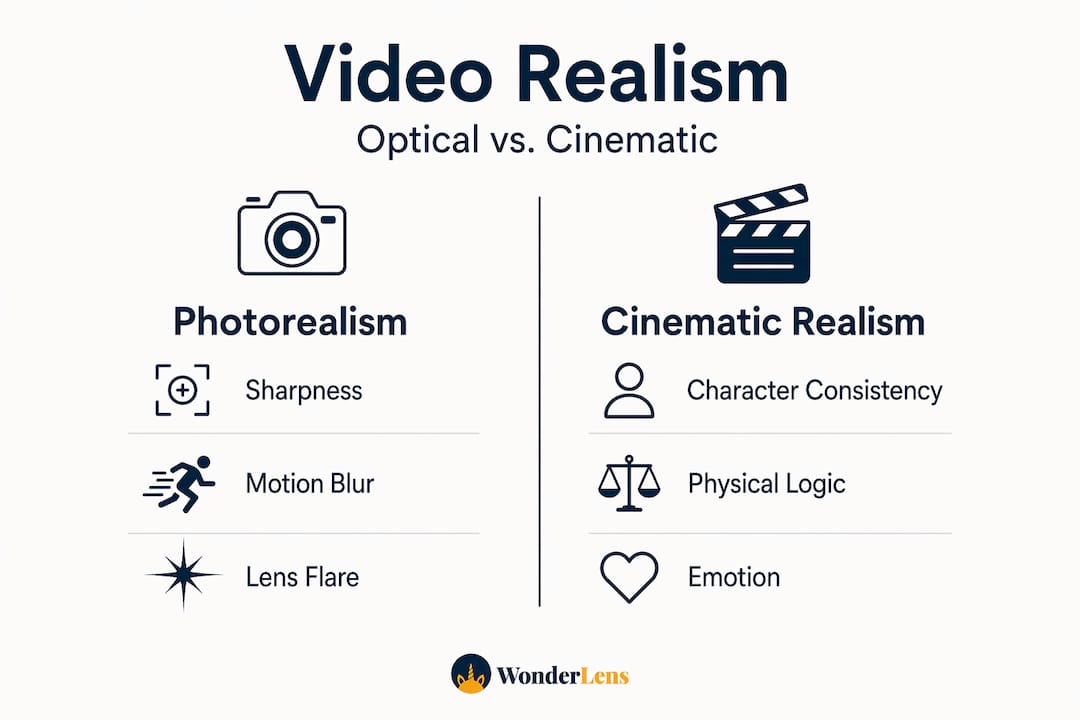
Photorealism focuses on optical precision, things like grain, motion blur, and lens flares. Cinematic realism asks how those elements contribute to emotional and narrative truth. That is a different question, and it requires a different creative approach.
Common pitfalls that break AI video realism
You might expect that the biggest enemy of visual fidelity in AI content is low resolution or outdated models. It's actually the opposite. The most common failure is too much perfection.
Artificially flawless videos trigger an immediate recognition response. Your brain has spent a lifetime cataloging how real footage looks, and real footage is never perfect. It has focus drift. Slight wobble. The occasional lens flare at a bad angle. When those signals are absent, something registers as wrong even if the viewer can't name it.
Here are the most frequent ways AI video realism collapses:
- Temporal inconsistency: A character's face slightly changes between frames, or a shadow shifts without the light source moving. This is the most common artifact of frame-by-frame generation and the hardest for viewers to ignore.
- Motion errors: Objects accelerate or decelerate in ways that violate physics. A door swings too smoothly. Hair moves without weight. These small failures accumulate quickly.
- Character drift: In longer sequences, AI-generated characters can gradually shift in appearance, losing the identity consistency that makes a scene feel like it's following a real person.
- Generic "cinematic" prompting: Asking an AI for a "realistic, cinematic scene" gives it too little to work with. The model fills in gaps with statistical averages, which look like every other AI video, not like a specific creative choice.
AI-generated high-fidelity videos can now fool both human viewers and AI-powered verification tools, which confirms how effective the best techniques are. But it also means the gap between great AI video and mediocre AI video has never been more visible.
Pro Tip: Specify hardware imperfections directly in your prompts. Try "16mm film grain," "anamorphic lens distortion," or "handheld camera wobble." Prompting for specific imperfections forces the model to replicate the statistical signatures of real capture instead of generating a clean, generic result.
Applying visual realism to your storytelling workflow
Knowing what visual realism in AI videos means is only useful if you can apply it. Here is how to bring these principles into your actual production process.
- Choose tools with physics reasoning. AI video realism now depends on logical coherence, not just appearance. Prioritize models that can maintain physical interactions and scene continuity across multiple shots. Tools lacking implicit physics priors will increasingly fall behind for high-end storytelling.
- Build narrative continuity into your prompts. For multi-shot sequences, describe how each clip connects to the last. Reference the same light source, the same spatial relationships, the same character state. This gives the model the context it needs to maintain coherence.
- Use environment and hardware specifics. Instead of "a cozy room at dusk," try "a living room with warm tungsten light at 3200K, slight window flare from the left, shot on a 35mm lens." The more your prompt reads like a cinematographer's shot list, learn more about realistic visual effects to inform your language.
- Balance fidelity with emotional intent. A horror scene benefits from desaturated tones and shallow depth of field. A family memory benefits from warm light and soft focus. Your visual choices should serve the story, not just demonstrate what the AI can technically produce.
- Test on critical details first. Hands, eyes, water, and fabric are the classic failure points for AI video realism. If your chosen tool handles these well, it will likely handle simpler elements without trouble.
Virtual production teams working in immersive content creation use similar principles, specifying environmental conditions precisely so that AI-rendered elements can be composited with real-world captures seamlessly. You can apply the same logic to fully AI-generated work.
My take on where AI visual realism is actually heading
I've spent years watching creators get distracted by whatever was technically impressive at the moment. High resolution, smooth motion, photorealistic textures. Every wave brought a new benchmark, and every benchmark eventually became the floor.
What I've learned is this: the creators who produce genuinely moving work with AI video are not chasing perfection. They are chasing truth. Real footage is imperfect because cameras are imperfect, because the world is messy and light is inconsistent and people don't always hold still. Those imperfections are what make footage feel witnessed rather than constructed.
The shift from pattern-matching to reasoning-based generation is genuinely exciting to me, not because it makes AI video look better, but because it makes AI video think better. A model that understands cause and effect can tell a more honest story. And honestly, that is what filmmaking has always been about.
My advice? Resist the urge to use every new capability just because it's available. Integrate AI realism thoughtfully. Ask yourself whether each technical choice serves the emotional truth of what you're making. The tools will keep improving. Your creative judgment is what makes the difference.
— Jeremiha
See visual realism in action with Wonderlens
If you want to see exactly how physics-based lighting, shadow casting, and motion coherence come together in a real AI video, Wonderlens is worth experiencing firsthand.

Wonderlens builds all of these principles into every video it generates, placing animated characters like Santa, unicorns, and fairies inside your actual home environment with lighting that matches your real space. It is not a sticker overlay. It is not a filter. The Santa Claus in your living room video is a clear example of how AI can produce a short, 10-second magical moment where the character catches your room's actual light and casts a genuine shadow. For creators who want to see cinematic AI realism applied to storytelling that actually makes people feel something, this is a useful reference point. Holiday magic and digital realism intersect in ways that reveal what this technology can do at its best.
FAQ
What is visual realism in AI videos?
Visual realism in AI videos refers to how convincingly an AI-generated video replicates the look, motion, and physical behavior of real-world footage. It includes temporal consistency, physics accuracy, and authentic micro-details like grain and camera movement.
Why do some AI videos look fake even at high quality?
Flawless, overly perfect videos often feel artificial because real footage always contains subtle imperfections. Missing cues like focus drift, camera shake, and lens distortion signal to viewers that the footage was not actually captured in the world.
How do I make AI video look more realistic?
Specify hardware and environmental conditions in your prompts, such as film stock type, lens focal length, and lighting temperature. Prompting for controlled imperfections like 16mm grain or lens distortion significantly improves perceived realism.
What is the difference between photorealism and cinematic realism in AI?
Photorealism focuses on optical accuracy, while cinematic realism prioritizes emotional plausibility and narrative coherence. The most effective AI video work addresses both, using visual and narrative truth together.
Which AI video features matter most for storytelling?
Physics reasoning, character identity consistency, and atmospheric continuity are the features that most directly support storytelling. Tools that maintain these qualities across multi-shot sequences give filmmakers the narrative consistency needed for compelling work.
Recommended
- What is visual realism in home videos? Make magic feel real — WonderLens | WonderLens
- Realistic Visual Effects Explained for Filmmakers — WonderLens | WonderLens
- What realism in digital media means for holiday magic — WonderLens | WonderLens
- Why Realism Is Important in Holiday Animations — WonderLens | WonderLens