Explain Shadow Realism Techniques for Visual Artists
May 29, 2026

Shadow realism techniques are defined as the methods artists and digital creators use to depict how light interacts with form, producing believable depth, volume, and spatial grounding in any visual medium. Whether you work in Unreal Engine 5, watercolor, or AI-generated animation, understanding shadow realism is what separates flat imagery from work that feels genuinely three-dimensional. These techniques span both digital rendering pipelines and traditional art shading methods, and mastering them transforms how your audience perceives light, space, and character in every frame.
What are the fundamental principles of shadow realism?
Shadow realism rests on one foundational distinction: core shadows differ from cast shadows, and confusing the two is the single most common reason beginner work looks vague and unanchored. A core shadow (also called a form shadow) lives on the object itself, defining its volume and curvature. A cast shadow falls on surrounding surfaces and encodes the relationship between the object, the light source, and the environment.
Beyond that distinction, realistic shading requires five tonal zones under a single light source: highlight, lit area, mid-tone, core shadow, and reflected light. Omitting or merging any of these zones causes form to appear flat rather than three-dimensional. Think of a sphere lit from the upper left. The highlight sits at the brightest point, the lit area spreads outward, the mid-tone transitions toward the shadow side, the core shadow marks the darkest band, and reflected light bounces back from nearby surfaces to soften the very edge.
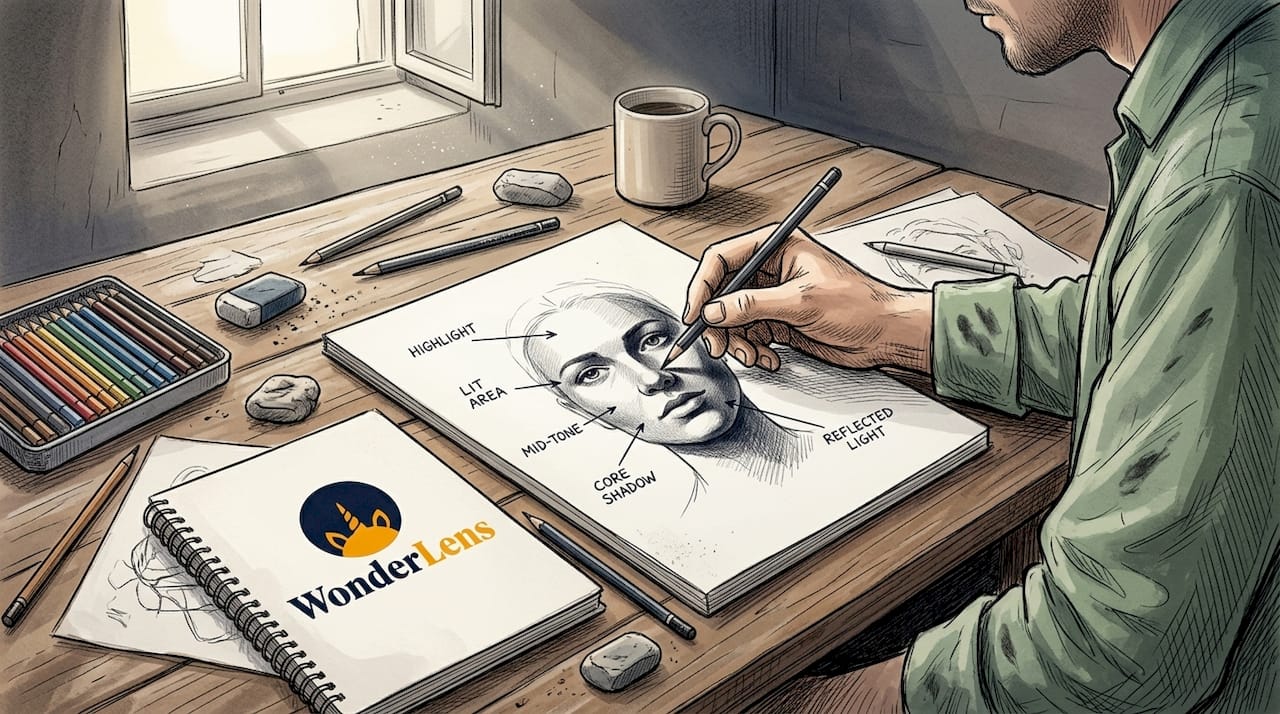
Shadow realism also involves color and temperature shifts caused by ambient and bounced light, not just value changes. Shadows are not pure black. They carry subtle hues from the surrounding environment, a cool blue cast outdoors on a sunny day, or a warm amber glow near candlelight. This is why treating shadows as a simple dark overlay always looks wrong.
The softness of shadow edges matters just as much as tonal value. A hard-edged shadow signals a small, distant, or intense light source. A soft, gradual penumbra signals a large or diffuse source. Getting edge transitions right is what makes shadows feel physically plausible rather than pasted on.
- Core shadow: Defines volume on the object's surface itself
- Cast shadow: Projects onto other surfaces, anchoring the object in space
- Five tonal zones: Highlight, lit area, mid-tone, core shadow, reflected light
- Edge softness: Controlled by light source size and distance
- Color temperature: Shadows carry ambient hues, not neutral gray or black
How do digital rendering techniques implement shadow realism?
Digital shadow realism methods rely on mathematical sampling and filtering rather than artistic intuition, but the underlying goals are identical. Here is how the core pipeline works:
-
Shadow mapping basics. The renderer generates a depth map from the light's point of view. When rendering the final scene, each pixel is tested against this depth map to determine whether it sits in shadow. This is the foundation of nearly every real-time shadow system in use today.
-
Percentage Closer Filtering (PCF). Basic shadow maps produce aliased hard edges, so PCF softens them by averaging multiple nearby depth samples, typically across a 3x3 grid. The result is a smoother penumbra that reads as physically believable. Soft shadows in real-time rendering come from this multi-sample averaging, trading increased computation for visual quality.
-
Virtual Shadow Maps in UE5. Unreal Engine 5 introduced Virtual Shadow Maps, which deliver high-resolution contact shadows with smoother penumbra and reduced aliasing compared to older cascaded shadow map systems. Settings like resolution, ray count, and light mobility all affect the final shadow detail and softness.
-
Light source size and penumbra control. Increasing the Source Radius or Angle in UE5 produces softer shadow edges by creating wider penumbra regions, along with warm color tones and gradual transitions. This single parameter adjustment is one of the fastest ways to push digital shadows toward cinematic quality.
-
Colored penumbra techniques. Colored penumbra methods add subtle color variation at shadow edges to enhance realism. Implementation through engine shader edits allows low-cost addition of warm shadow coloration, improving immersive effects. These work best with wide penumbra and dynamic lights.
-
Lumen and indirect lighting. UE5's Lumen system enhances shadow realism through indirect lighting and bounce light, which softens edges and adds color bleeding. This is crucial for warm cinematic shadows even when direct penumbra tuning is moderate.
Pro Tip: When shadow quality feels off in UE5, check your shadow map resolution before adjusting filter kernel size. Pushing PCF filtering too far without sufficient resolution generates blurred artifacts that undermine realism rather than improve it.
What traditional art techniques support shadow realism in drawing and painting?
Traditional shadow realism methods rely on observation and mark-making to achieve what digital pipelines do through computation. The most widely used shading techniques include:
- Hatching: Parallel lines that build value through density and spacing
- Cross-hatching: Overlapping sets of hatched lines for deeper tonal range
- Blending: Smudging graphite, charcoal, or pastel to create smooth gradients
- Stippling: Dots of varying density to build tonal zones, common in ink work
- Scumbling: Loose, circular marks layered for textured, organic shadow areas
Each technique serves a different purpose. Cross-hatching preserves mark energy and suits expressive figure drawing. Blending works well for smooth forms like skin or ceramic surfaces. Stippling is slow but produces extraordinary tonal control in detailed illustration work.
The most damaging mistake in traditional shadow drawing is using pure black for shadows. Real shadows carry reflected light and color temperature, so a pure black shadow instantly reads as artificial. The second most common error is merging tonal zones, particularly the mid-tone and core shadow, which collapses the form and makes objects look flat.
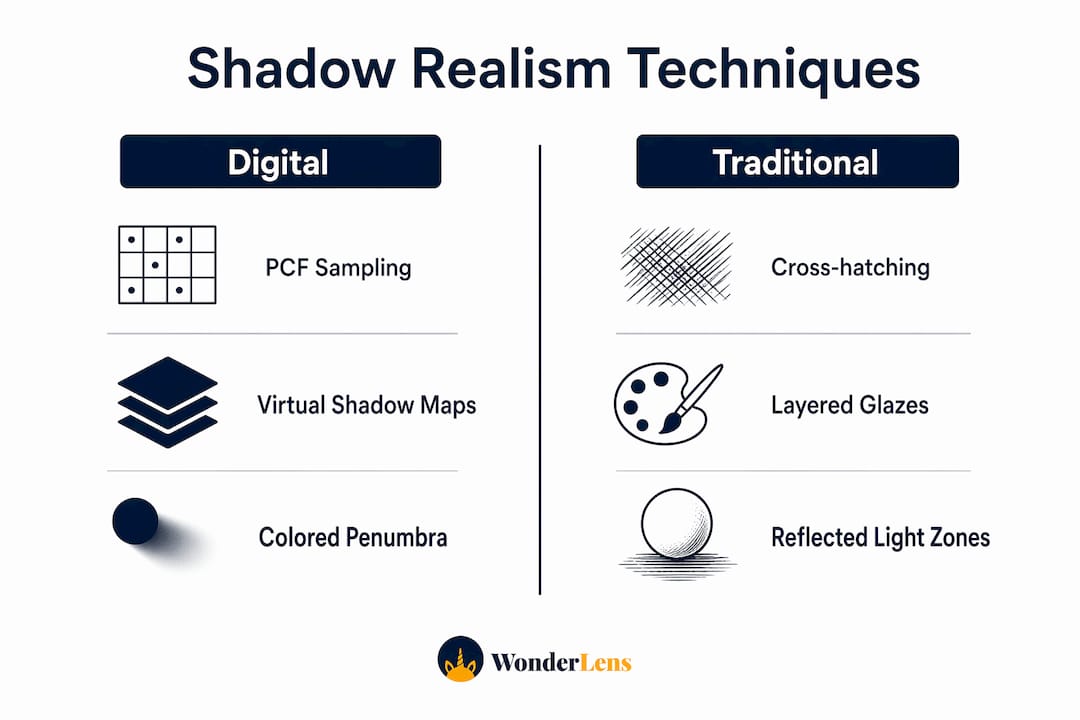
In watercolor, shadows should be built with layered transparent glazes from light to dark, allowing each layer to dry fully before adding the next. Overworking wet watercolor shadows produces muddy, flat results. The recommended approach is to stop after a few glazing layers to maintain softness and clarity.
Pro Tip: In pencil or charcoal work, place your reflected light zone before your core shadow. Seeing the full tonal range early prevents you from pushing the core shadow too dark and losing the form's three-dimensionality.
How do shadow realism techniques differ and converge across media?
Both digital and traditional approaches share the same physical foundation: a light source, tonal zones, and edge softness. The methods for achieving them diverge sharply, but understanding both makes you a stronger visual storyteller in either medium.
| Dimension | Digital rendering | Traditional art |
|---|---|---|
| Shadow softness | PCF sampling, Virtual Shadow Maps, Source Radius adjustment | Blending, hatching density, layered glazing |
| Color in shadows | Colored penumbra shaders, Lumen bounce light | Color mixing, glazing with complementary hues |
| Tonal zones | Automated by lighting engine and shader pipeline | Manually observed and constructed by the artist |
| Common pitfalls | Shadow acne, aliasing, floating shadows, over-blurred artifacts | Pure black shadows, overworked glazes, merged tonal zones |
| Strengths | Precision, repeatability, real-time feedback | Expressive mark variation, tactile depth, mood control |
The most important convergence point is color temperature in shadows. Digital colored penumbra techniques and traditional glazing with warm or cool pigments solve the same problem: shadows are not neutral gray. They carry the color of the ambient environment. Realism in digital media and in traditional painting both depend on this principle.
Where digital workflows struggle is with shadow acne, a visual artifact caused by self-shadowing errors in depth maps, and floating shadows, where objects appear to hover above surfaces. Traditional artists face the opposite challenge: overworking, which destroys the freshness and softness that make shadows feel luminous.
What practical tips enhance shadow realism in 2026 visual projects?
Emerging research and engine updates in 2026 have pushed shadow realism forward significantly. Here are the most effective approaches for filmmakers, animators, and hobbyists right now:
- Layer your shadows. Multiple shadow layers with adjusted opacity and blur produce more realistic results than a single strong shadow. Layering creates the natural depth and complexity shadows exhibit in the real world, whether you are working in CSS, compositing software, or a painting.
- Add contact shadows. A sharp, dark shadow directly beneath an object where it meets a surface grounds it visually. Without contact shadows, characters and objects appear to float.
- Use indirect lighting and bounce. Bounce light from nearby colored surfaces adds warmth and color variation to shadow areas, which is what gives cinematic lighting its richness. UE5's Lumen handles this automatically; traditional artists must observe and mix it manually.
- Avoid shadow acne in digital pipelines. Increase shadow map resolution before widening your PCF filter kernel. Bias settings in your renderer can also reduce self-shadowing artifacts without sacrificing edge quality.
- Incorporate subtle shadow coloration. Even a slight warm or cool tint in shadow areas increases immersion dramatically. This applies equally to digital shaders and traditional glazing.
- Watch emerging AI research. Research is progressing toward illumination-aware shadow generation conditioned on light-geometry interaction, aiming to unify shadow generation and relighting for fewer artifacts in AI and digital content. This will change how AI-generated video handles shadow placement within the next few years.
For filmmakers working with cinematic photography techniques, physically plausible soft-edged shadows are already a standard expectation in visual effects for film, TV, and interactive media.
Key takeaways
Shadow realism requires distinguishing core shadows from cast shadows, applying five tonal zones, and controlling edge softness through either computational filtering or observational mark-making.
| Point | Details |
|---|---|
| Core vs. cast shadows | Confusing these two types collapses form and removes spatial grounding from any image. |
| Five tonal zones | Highlight, lit area, mid-tone, core shadow, and reflected light must all be present for convincing volume. |
| Digital softness tools | PCF, Virtual Shadow Maps, and Source Radius adjustments in UE5 control penumbra quality directly. |
| Color in shadows | Shadows carry ambient hues and temperature shifts, not neutral gray or pure black. |
| Layered approach | Multiple low-opacity shadow layers produce more natural depth than a single dark overlay in any medium. |
Why I think most artists skip the hardest part of shadow realism
After years of working across digital and traditional media, I keep seeing the same gap. Artists spend hours on highlights and color palettes, then rush the shadows with a single dark layer and call it done. The result always looks off, and most people cannot articulate why.
The uncomfortable truth is that shadows are where the real spatial information lives. A highlight tells you where the light is. A shadow tells you the shape of the object, the distance to the surface below it, the color of the environment, and the size of the light source. That is four separate pieces of information packed into one area most people treat as an afterthought.
My advice: spend one full session doing nothing but studying cast shadows in your home. Notice how the shadow under a coffee mug has a sharp edge close to the mug and a soft edge further away. Notice the slight warm tint where light bounces off the wooden table. That observation, translated into your work, is worth more than any technical tutorial.
For digital artists, resist the temptation to crank up PCF filtering as a shortcut to soft shadows. Resolution matters more. A high-resolution shadow map with moderate filtering always beats a low-resolution map with heavy blurring. The blurred version looks soft but loses contact shadow detail, which is exactly what grounds objects in a scene.
The most exciting development right now is illumination-aware AI shadow generation. When that technology matures, it will handle the geometric relationship between light and form automatically. Until then, understanding these principles yourself is what separates work that feels magical from work that just looks processed.
— Jeremiha
See shadow realism in action with Wonderlens
Wonderlens puts these exact shadow realism principles to work in every video it generates. When a fairy glides through your living room or a dragon lands on your kitchen floor, the shadows it casts match your actual room lighting, anchor the character to your real surfaces, and shift in color with your environment.

That level of realism comes from the same techniques covered in this article: layered shadow rendering, contact shadow grounding, and color-temperature-aware lighting. You can see it clearly in the fairy bedroom video, where the character catches your room's ambient light and casts a soft, warm shadow that moves with her. If you want to explore how visual realism in AI videos applies to your own projects, Wonderlens is the fastest way to see these principles in a finished, shareable result.
FAQ
What is the difference between a core shadow and a cast shadow?
A core shadow sits on the object itself and defines its three-dimensional volume. A cast shadow falls on surrounding surfaces and encodes the spatial relationship between the object and the light source.
How does PCF improve shadow quality in real-time rendering?
PCF softens shadow edges by averaging multiple nearby depth samples, typically across a 3x3 grid, reducing aliasing and producing a smoother penumbra without requiring ray tracing.
Why do shadows in drawings look flat even when they are dark enough?
Flat shadows usually result from merging tonal zones or using pure black, which eliminates reflected light and color temperature variation. Realistic shadows require all five tonal zones and subtle ambient color.
What does UE5 Virtual Shadow Maps improve over older shadow systems?
Virtual Shadow Maps in UE5 deliver higher-resolution contact shadows with smoother penumbra and reduced aliasing compared to cascaded shadow maps, with resolution and ray count settings that directly control shadow detail.
How do I add color to shadows in traditional painting?
Build shadows with layered transparent glazes using warm or cool pigments that reflect the ambient environment. Start light, allow each layer to dry fully, and stop after a few layers to preserve softness and avoid muddy results.
Recommended
- Realistic Visual Effects Explained for Filmmakers — WonderLens | WonderLens
- What Is Visual Realism in AI Videos for Filmmakers. WonderLens | WonderLens
- What is visual realism in home videos? Make magic feel real — WonderLens | WonderLens
- Why Realism Is Important in Holiday Animations — WonderLens | WonderLens