The Role of Fantasy in Children's Videos Explained
July 12, 2026
Fantasy in children's videos is defined as the deliberate use of impossible, magical, or imaginative content to stimulate cognitive and emotional development in young viewers. The role of fantasy in children's videos goes far beyond simple entertainment. Research shows that high-quality fantasy engagement predicts accelerated creativity development with an odds ratio of 4.91 by first grade. That number means children who engage deeply with fantasy content are nearly five times more likely to show advanced creative thinking than peers with limited exposure. At the same time, fantasy media can temporarily strain executive functions, which means caregivers need to understand both sides of the equation.
How does fantasy in children's videos enhance creativity?
Fantasy content builds creativity by forcing children's brains to work in ways that realistic content simply cannot. When a child watches a dragon soar through a living room or a fairy scatter golden light across a bedroom, their brain must construct entirely new mental models. That process of building something from nothing is the foundation of divergent thinking, the ability to generate multiple solutions to a single problem.
A longitudinal study tracking 230 children over five waves from pre-K to first grade found that high-quality fantasy play predicts creativity trajectories well into formal schooling. The effect size is striking. Children who regularly engaged with rich fantasy content showed measurable advantages in creative output compared to those who did not. This is not a short-term boost. The benefits compound over time.
Fantasy also supports symbolic representation, the ability to let one thing stand for another. Research confirms that fantasy promotes symbolic representation and social-emotional development by giving children a safe space to process complex feelings through characters and storylines. A child watching a brave little unicorn face a scary forest is also rehearsing courage in their own mind.
Common fantasy elements in children's videos that drive imagination include:
- Magical transformations: Objects or characters changing form teach children that reality is flexible and problems have unexpected solutions.
- Impossible journeys: Stories set in enchanted worlds stretch spatial reasoning and narrative comprehension.
- Talking animals: Animal protagonists give children emotional distance to explore fear, friendship, and loss safely.
- Recurring magical rules: Consistent internal logic in a fantasy world (a spell always requires three words, for example) builds pattern recognition and logical thinking.
Pro Tip: After a fantasy video, ask your child one open-ended question: "What would you do if you had that magic?" This simple prompt activates creative thinking and extends the developmental benefit beyond the screen.
What are the cognitive costs of fantasy media for children?
Fantasy media does carry a real cognitive cost, and parents deserve a straight answer about what that means. A meta-analysis of 16 studies involving 1,297 children aged 1.5–6 years found that viewing fantastical media causes immediate, temporary deficits in inhibitory control and cognitive flexibility compared with realistic media. Inhibitory control is the ability to stop an automatic response. Cognitive flexibility is the ability to switch between mental tasks. Both are core executive functions that children use constantly in school and social settings.
The mechanism behind this is called the fantasy effect. When children watch impossible events, their brains must inhibit real-world logic to accept what they are seeing. A dragon breathing fire does not fit any existing schema a child holds. Processing that conflict taxes working memory and inhibitory resources simultaneously. The result is a temporary depletion of the very cognitive tools children need right after viewing.
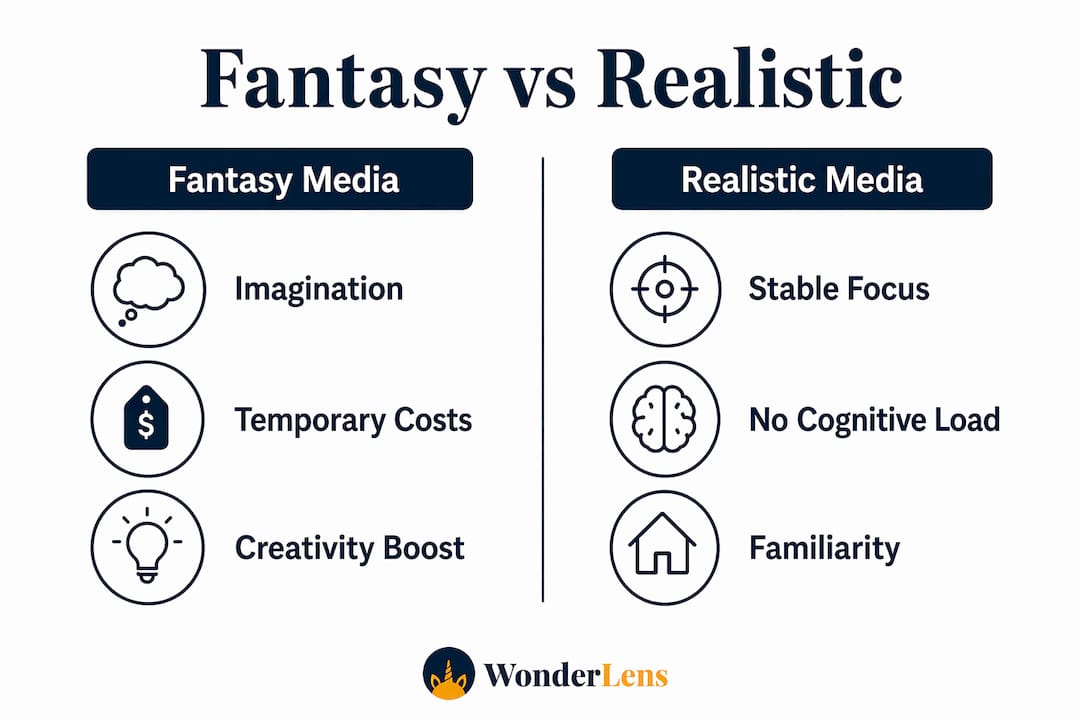
| Cognitive function | Effect after fantasy media | Effect after realistic media |
|---|---|---|
| Inhibitory control | Temporary deficit | Minimal change |
| Cognitive flexibility | Temporary deficit | Minimal change |
| Narrative comprehension | Strained by schema conflict | Supported by familiar logic |
| Working memory load | Elevated | Baseline |
The key word is temporary. These deficits are not permanent, and they do not indicate that fantasy content is harmful. They indicate that children's brains are working hard. The fantasy effect reflects cognitive burden, not content harm. Understanding this distinction helps caregivers make smarter choices about timing and pacing rather than avoiding fantasy content altogether.
Pro Tip: Avoid scheduling demanding tasks like homework or reading practice immediately after a fantasy video session. Give children 15–20 minutes of calm, unstructured time first to let executive functions recover.
Why does storytelling structure matter in fantasy children's videos?
Narrative structure is what separates a magical video that teaches from one that simply dazzles. Fantasy acts as a cultural transmission medium, carrying values, traditions, and emotional wisdom across generations through story. When a fantasy video follows a clear arc (a problem, a quest, a resolution), children internalize not just the story but the logic of how challenges get solved.
Animal characters play a specific and well-documented role in this process. An analysis of the 50 most-viewed YouTube children's read-aloud videos found that animal protagonists appeared in 29 of those 50 videos, with view counts ranging from 324,000 to 6 million. That dominance is not accidental. Animal characters give children emotional permission to feel big feelings without the self-consciousness that human characters can trigger.
Structured fantasy storytelling also supports language development and comprehension. When a child can predict what comes next in a story, they are building reading readiness. When a story surprises them within a logical framework, they are building critical thinking. The best fantasy videos for children do both.
The catch is that most popular children's read-aloud videos lack intentional comprehension design. They do not include interactive prompts, pauses for reflection, or questions that guide understanding. This is where you, as a caregiver, become the most important feature of any fantasy video your child watches.
Benefits of adult mediation during fantasy video viewing include:
- Asking prediction questions before key plot moments ("What do you think will happen next?")
- Naming emotions characters display ("She looks scared. Have you ever felt that way?")
- Connecting fantasy events to real-life experiences to reinforce comprehension
- Pausing to let children process surprising or emotionally intense scenes
How can parents balance fantasy exposure for healthy development?
Balancing fantasy exposure is not about limiting magic. It is about making sure magic works for your child rather than against them. Active fantasy engagement like pretend play delivers greater developmental benefits than passive screen viewing alone. The goal is to use fantasy videos as a launching pad, not a destination.
Here is a practical framework for caregivers:
- Pair fantasy videos with open-ended play. After watching a video featuring unicorns or dragons, set out art supplies, building blocks, or dress-up items. Let your child extend the story physically. This converts passive viewing into active creativity.
- Mix fantasy and realistic content. Alternating between imaginative stories and realistic content gives children's executive functions time to recover and prevents cognitive overload from accumulating across a viewing session.
- Choose videos with clear narrative structure. Look for fantasy content that follows a recognizable story arc. Episodic chaos without resolution offers less developmental value than a story with a beginning, middle, and end.
- Model imaginative thinking yourself. Research confirms that caregivers who model imagination and provide open-ended materials directly enhance children's cognitive flexibility. Sit down and play along. Your participation multiplies the benefit.
- Pace screen time thoughtfully. Short, focused fantasy video sessions followed by physical activity or pretend play produce better outcomes than long, uninterrupted viewing blocks.
The role of pretend play in toddler development reinforces this point clearly. Fantasy videos work best when they feed into hands-on imaginative play, not replace it. You can also explore how sensory play supports development alongside fantasy media for a well-rounded approach.
Pro Tip: Create a simple "story basket" after each fantasy video session. Fill it with three or four objects related to the video's theme. Let your child invent their own continuation of the story using those objects. This one habit bridges passive viewing and active creativity.
Key Takeaways
Fantasy in children's videos builds creativity and emotional intelligence, but its full benefit requires caregiver involvement, balanced pacing, and active play to complement screen time.
| Point | Details |
|---|---|
| Fantasy predicts creativity | High-quality fantasy engagement predicts advanced creative thinking with an odds ratio of 4.91 by first grade. |
| Cognitive costs are temporary | Fantasy media causes short-term deficits in inhibitory control and flexibility, not lasting harm. |
| Storytelling structure matters | Videos with clear narrative arcs build comprehension, language skills, and critical thinking more effectively. |
| Adult mediation multiplies value | Asking questions and connecting stories to real life dramatically improves educational outcomes from fantasy videos. |
| Active play extends the benefit | Pairing fantasy videos with open-ended pretend play delivers greater developmental gains than screen time alone. |
Fantasy videos and the caregiver's role: what the research actually shows
I have spent years watching the conversation about children's media swing between two extremes. Either fantasy is pure magic that can do no wrong, or screens are the enemy of childhood. Neither position holds up to scrutiny.
What the 2026 research actually shows is more interesting and more useful. Fantasy content is cognitively demanding in a way that realistic content is not. That demand is a feature, not a bug, as long as you manage it thoughtfully. The children who benefit most from fantasy videos are not the ones who watch the most. They are the ones whose caregivers treat viewing as a conversation starter rather than a babysitter.
The trend I find most compelling right now is the move toward personalized fantasy experiences. When a child sees a dragon landing in their actual living room, the cognitive and emotional engagement spikes in ways that generic fantasy content cannot match. The magic of fantasy in home settings is not just novelty. It is relevance. A child's brain lights up differently when the impossible happens in a familiar space.
My honest observation after reviewing the current research: the caregivers who get the best outcomes are not the ones who curate the perfect playlist. They are the ones who stay in the room, ask one good question, and then hand their child a box of crayons.
— Jeremiha
Wonderlens: bringing fantasy characters into your child's world
Wonderlens gives you a way to make fantasy feel genuinely real for your child, right inside your home. The platform uses AI-driven rendering to place characters like unicorns, dragons, fairies, and Santa into your actual living space, complete with accurate lighting, shadows, and movement. The result is a magical personalized video your child will want to watch again and again.

Each video is generated from a photo of your home, so the fantasy feels anchored in a familiar, safe space. That combination of wonder and realism is exactly what the research points to as most engaging for young children. Credits start at $1.99, making it easy to create a memorable moment for a birthday, holiday, or any ordinary Tuesday that deserves a little magic. Visit Wonderlens to create your first video today.
FAQ
What is the role of fantasy in children's videos?
Fantasy in children's videos stimulates creativity, symbolic thinking, and social-emotional development by presenting impossible events that require children to build new mental models. Research links high-quality fantasy engagement to measurably advanced creative thinking by first grade.
Does fantasy media harm children's cognitive development?
Fantasy media causes temporary deficits in inhibitory control and cognitive flexibility, but these effects are short-lived and not harmful. The cognitive strain reflects the brain working hard to process impossible events, not lasting damage.
How much fantasy content is appropriate for young children?
No single screen time limit fits every child, but mixing fantasy with realistic content and following viewing with active pretend play reduces cognitive overload. Short, structured sessions with caregiver involvement produce the best developmental outcomes.
Why do animal characters appear so often in children's fantasy videos?
Animal protagonists appeared in 29 of the 50 most-viewed children's read-aloud videos on YouTube. They give children emotional distance to explore complex feelings like fear and loss without the self-consciousness that human characters can trigger.
How can caregivers make fantasy videos more educational?
Adult mediation is the single most effective tool. Asking prediction questions, naming character emotions, and connecting story events to real-life experiences significantly improves comprehension and educational outcomes from fantasy-themed video content.
Recommended
- The Role of Dragons in Personalized Videos for Kids. WonderLens | WonderLens
- The Role of Fantasy Characters in Family Traditions. WonderLens | WonderLens
- How to make Easter fantasy videos for magical memories — WonderLens | WonderLens
- Fairy video animation: A parent's guide to magical memories — WonderLens | WonderLens