Creative Video Christmas Card Ideas for Every Family
August 11, 2026
A short, personalized video of 15–30 seconds paired with a festive template or a cinematic AI photo-to-video clip is the fastest way to make a holiday greeting that people actually remember. The best video Christmas card ideas share five things: a warm, specific message; a clear visual style; upbeat royalty-free music; a length under 30 seconds; and a delivery channel matched to the recipient.
Quick wins you can start today:
- Record a short selfie video in front of your decorated tree, add a name overlay, and send via iMessage or WhatsApp.
- Upload a family photo to Wonderlens and generate a cinematic 10-second clip with Santa or another holiday character appearing right in your living room.
- Compile several short clips from family members into one group card using a free video editor like CapCut.
Key Takeaways
The single most effective video Christmas card combines a short runtime (under 30 seconds), one specific personal detail, and a visual style matched to the recipient.
| Point | Details |
|---|---|
| Keep it short | 15–30 seconds holds attention; under 15 seconds for social Stories. |
| Personalize the opening | A recipient's name or a shared memory in the first two seconds stops the scroll. |
| Match format to channel | MP4 for messaging and email; 9:16 portrait for Stories; 1:1 for Instagram feed. |
| Send 3–7 days early | Cards sent before December 22 land before inboxes fill up on Christmas Eve. |
| Try Wonderlens for magic | Wonderlens generates a cinematic 10-second character clip from your home photo, starting free. |
Table of Contents
- What are the best video Christmas card ideas right now?
- How do you make a video Christmas card step by step?
- How do you personalize a holiday video card so it feels special?
- How do you collect and compile group video messages into one card?
- Which tool types and formats should you use for your holiday video card?
- When and how should you send your video Christmas card?
- What are the music and privacy rules for U.S. senders?
- Why short, cinematic holiday clips work better than you might expect
- Wonderlens makes cinematic holiday clips fast and easy
- Sources
What are the best video Christmas card ideas right now?
-
Heartfelt selfie message (around 15 seconds). You, your family, or your pet in front of the tree. Best for close friends and grandparents. Assets needed: a phone and good window light.
-
Photo montage with captions (25–30 sec). String together 8–10 still photos with short text overlays and a soft instrumental track. Great for long-distance relatives who want to see how the year went.
-
Stop-motion ornament reveal (brief duration). Move ornaments frame by frame to spell a name or reveal a message. Best for creative senders who want something genuinely surprising on social media.
-
Countdown to Christmas (short). A quick countdown with a festive number animation. Perfect for coworkers or social posts in the week before December 25.
-
Holiday recipe demo (around half a minute). Film yourself making one signature cookie or drink. Works beautifully for food-loving friends and doubles as shareable Instagram content.
-
Pet cameo card (short). Your dog in a Santa hat, your cat batting at tinsel. No script needed. Best for anyone who follows your pet on social media.
-
Animated family storybook (around 20 seconds). Use a template that frames your photos inside a storybook or snow globe. Ideal for sending to kids in the family who love a little magic.
-
Cinematic AI character surprise (10 sec). Place Santa, a fairy, or a dragon into a photo of your actual living room using AI Christmas video tools that match the character's lighting and shadows to your space. The most memorable option for young children.
-
Karaoke singalong (short). Film yourself (or the whole family) singing the first verse of a classic carol. Funny, warm, and impossible to ignore in a crowded inbox.
-
Funny blooper reel (brief). Collect the outtakes from your year and set them to an upbeat track. Best for close friends who appreciate candid humor over polished production.
-
Map-style travel memory (about 20 seconds). Animate a simple map showing the places your family visited this year, with a photo from each stop. Great for families who traveled and want to recap the year visually.
-
Charity shoutout card (short). Record a short message naming a cause you donated to in the recipient's honor. Meaningful for professional contacts and anyone who prefers purpose over presents.
How do you make a video Christmas card step by step?
The core workflow is simple: choose your format, gather your media, edit, add music and text, then export and share. Here is how to move through it without getting stuck.
- Pick one idea from the list above and decide on your delivery channel (text, email, or social). This locks your aspect ratio before you shoot a single frame.
- Gather your assets. Photos, short clips, or a single selfie recording. Aim for 720p minimum; most modern phones shoot at 1080p by default.
- Choose a template or tool. Template editors are fastest for montages. AI photo-to-video tools like Wonderlens work best for cinematic character moments. See the animated memories workflow for a detailed breakdown.
- Record or upload your media. Shoot in landscape (16:9) for email and TV screens; portrait (9:16) for Instagram Stories and WhatsApp.
- Add music and text. Keep music at roughly 20% volume so your voice or captions stay clear. Use a single headline font for all text overlays.
- Trim to length. Under 30 seconds for most channels; 10–15 seconds for social Stories.
- Export as MP4 (H.264). This format plays on every device and compresses well for messaging apps. Use an animated GIF only for short looping posts where autoplay matters, as GeeksforGeeks notes that GIFs with festive motion are quick-to-share formats compatible with social and messaging apps.
- Send and confirm delivery. Large files (over 25 MB) often get compressed by messaging apps. Upload to Google Drive or Dropbox and share the link instead.
Pro Tip: Shoot near a window in the late afternoon. Natural side-lighting gives faces a warm golden glow that no filter can fully replicate, and it makes even a 20-second selfie card look intentional.
How do you personalize a holiday video card so it feels special?
Small choices create the biggest emotional impact. A card addressed to "the whole family" feels generic; one that opens with "Hey, Grandma Carol" feels like a hug.
Key personalization levers:
- Recipient name overlay: Add the person's first name in the first two seconds. It stops the scroll immediately.
- One personal line: Reference a shared memory or inside joke. Even a single sentence ("Still thinking about that Thanksgiving pie") makes the card feel irreplaceable.
- Captions for accessibility: Many people watch videos on mute. Burn in simple captions or add a subtitle file so the message lands either way.
- Music matched to the recipient: Upbeat pop for your college friends; soft acoustic for grandparents; instrumental jazz for professional contacts.
- Consistent visual kit when sending multiple cards: Pick two or three colors, one headline font, and one music style. This keeps your cards recognizable without requiring pro editing skills.
For tone, a four-line script structure works well across most styles: greeting, one shared memory, one warm wish, and a sign-off. Heartfelt cards run 20–25 seconds at a relaxed pace; funny cards work best at 15 seconds or less before the joke lands; professional cards should stay under 20 seconds and skip the personal memory line entirely.
Pro Tip: For personalized holiday videos sent to multiple households, record one "base" take and swap only the name overlay and the opening greeting line. You save time without losing the personal touch.
How do you collect and compile group video messages into one card?
The workflow is: invite, record, collect, trim, then stitch. Getting the invite right saves you hours of reformatting later.
- Send a clear invite message specifying: portrait orientation (9:16), 10–15 seconds maximum, well-lit face, and a simple prompt ("Say your favorite holiday memory with [recipient's name]").
- Set a firm deadline at least four days before your send date. Late clips break the assembly timeline.
- Name the files consistently when contributors send them (e.g., "FirstName_LastName_Clip.mp4") so you can sort them quickly.
- Collect via a shared Google Drive folder rather than a group chat. Chat compression degrades video quality noticeably.
- Trim each clip to 8–12 seconds and normalize audio levels so no one sounds dramatically louder than the others.
- Stitch in a logical order: open with the most energetic clip, close with the most heartfelt, and place the rest in between.
- Add a simple title card at the start ("Happy Holidays from the whole team!") and a music bed underneath.
Final quality checklist before sending:
- Total length kept reasonably short to maintain attention
- Audio balanced across all clips
- No abrupt jump cuts (add a half-second fade between clips)
- Exported as MP4 at 1080p
Which tool types and formats should you use for your holiday video card?
Pick the tool that matches your idea and your comfort level with editing. Speed matters more than features for most holiday cards.
| Tool type | Speed | Customization | Output quality | Cost model |
|---|---|---|---|---|
| Template editors | Very fast | Moderate | Good | Free tier plus paid upgrades |
| eCard services | Fast | Low | Moderate | Subscription or per-send fee |
| AI photo-to-video | Fast | High | Cinematic | Credit-based or subscription |
| Phone-record workflow | Instant | Full | Variable | Free |
For format, the defaults are straightforward. MP4 (H.264) works for every channel: text messages, email, Instagram feed, and YouTube. Animated GIFs suit short looping posts on social platforms where autoplay is guaranteed. For aspect ratio, use 16:9 for email and desktop viewing, 9:16 for Stories and WhatsApp, and 1:1 for Instagram feed posts.
For cinematic photo-to-video moments, Wonderlens stands out. It places holiday characters like Santa directly into a photo of your home, with AI-matched lighting and shadows that make the scene look genuinely real rather than pasted on. You can explore photo-to-video app options to compare approaches before committing.

When and how should you send your video Christmas card?
Send 3–7 days before December 25 for most recipients. Cards sent earlier get buried; cards sent on December 24 arrive when inboxes are already full.
Channel-specific guidance:
- WhatsApp or iMessage: Send with a short text like "Made this for you this year 🎄" followed by the video or link. Keep the text under 10 words so the video is the focus.
- Email: Use a subject line like "A little something from [Your Name] this Christmas." Put the video thumbnail in the first screen of the email body with a clear play button.
- Instagram: Post to Stories for 24-hour reach or to Reels for longer visibility. Add a caption of 1–2 lines and three to five relevant hashtags.
- Private link (Google Drive or Dropbox): Best for group cards or large files. Paste the link into a short personal message rather than sending the raw URL alone.
Quick dos and don'ts:
- Do send work contacts during business hours (Tuesday through Thursday, 9 AM–11 AM local time works well).
- Do compress files over 25 MB before attaching to email to avoid spam filters.
- Don't send to a mass BCC list with a generic subject line; personalize at least the subject.
- Don't post a video publicly if it includes faces of people who haven't given permission.
What are the music and privacy rules for U.S. senders?
Avoid copyrighted commercial tracks unless you have a license; use royalty-free music or platform-licensed libraries for any public sharing.
Music options ranked by safety:
- Platform libraries (YouTube Audio Library, Instagram's licensed music for Reels): cleared for use on that platform only.
- Creative Commons tracks (Free Music Archive, ccMixter): check the specific license; some require attribution.
- Paid royalty-free services (Epidemic Sound, Artlist): cover most commercial and social uses with a subscription.
For private sharing, you have more flexibility, but the safest habit is to use royalty-free music everywhere.
Privacy checklist for U.S. senders: Get verbal or written permission before including another person's face in a publicly shared video. Keep home addresses, license plates, and financial documents out of the frame. Use a private link (not a public post) when distributing to a limited group. If you're using an AI tool that processes uploaded photos, review the platform's data policy before uploading images of minors.
Why short, cinematic holiday clips work better than you might expect
Most people assume a longer, more elaborate video card signals more effort and care. The opposite tends to be true. A 10–20 second clip that opens with something visually surprising, like Santa casting a real shadow across your living room floor, holds attention completely. A three-minute slideshow, no matter how lovingly assembled, loses most viewers before the halfway point.
What makes the short format work isn't brevity for its own sake. It's the combination of specificity (your actual home, your actual family) and a moment of genuine magic that the recipient didn't expect. That combination is exactly what personalized holiday videos done well deliver, and it's why families who try a cinematic AI clip once tend to make it a yearly tradition.
Wonderlens makes cinematic holiday clips fast and easy
If you want a video Christmas card that genuinely stops people mid-scroll, Wonderlens delivers it in minutes. The platform places holiday characters like Santa, fairies, or dragons directly into a photo of your home, with AI-driven lighting and shadow rendering that makes the scene look real rather than composited. Your first video is free, and additional credits start at $1.99 per clip.
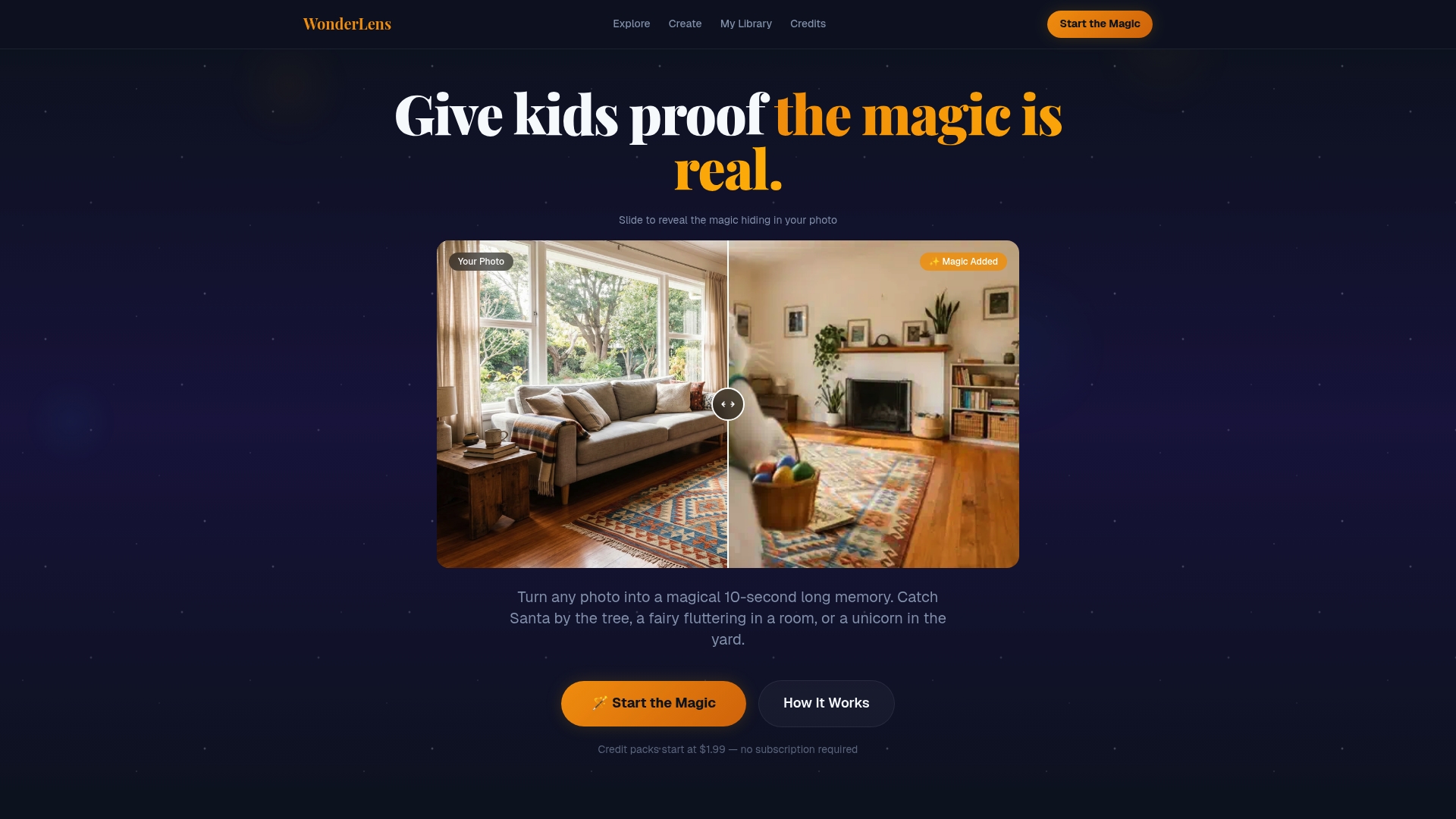
The workflow takes three steps: upload a photo of your space, choose a character, and let the AI render the scene. Download the finished 10-second clip and share it anywhere. No editing software, no design skills, no long-term commitment. For families who want a magical, shareable holiday memory without spending an afternoon in front of a timeline, it's the most direct path from idea to finished card.
Visit Wonderlens to generate your first free clip and see how your home looks with a little holiday magic in it.