Why Integrate Fantasy Figures for Families: A Parent's Guide
July 28, 2026
Integrating fantasy figures into family photos and videos makes experiences more engaging, memorable, and socially rich for children. Research from Scientific American shows that fantastical stories produce greater vocabulary growth than realistic ones, because impossible events pull children's attention into a deeper mode of processing. Lev Vygotsky's theory of imaginative play adds another layer: children build higher-order thinking by inhabiting roles and scenarios beyond their everyday experience. For parents, this means a dragon curling behind the couch or a fairy hovering near the Christmas tree isn't just a fun surprise. It's a small, science-backed investment in your child's development.
- Engagement: Fantastical violations of expectation focus attention and prime learning.
- Memory: Emotionally charged, novel scenes are encoded more deeply than routine ones.
- Bonding: Shared magical moments shift viewing from passive to active co-participation.
The best occasions to use these videos are holiday mornings, birthday reveals, bedtime wind-downs, and reward moments. Wonderlens makes it easy to place animated characters directly into a photo of your home, so the magic feels personal and real.
Table of Contents
- Why integrate fantasy figures? The cognitive and emotional benefits
- How fantasy elements change attention, memory, and social skills
- When should you use fantasy figures?
- How to integrate fantasy figures into your home photos and videos
- What are your options for creating fantasy figure videos?
- Safety, consent, and privacy when sharing personalized videos
- How Wonderlens applies these ideas to create safe, realistic holiday surprises
- Key Takeaways
- What parents often underestimate about fantasy figures
- Wonderlens brings the magic home
- Further reading and sources
Why integrate fantasy figures? The cognitive and emotional benefits
Fantasy figures do more than delight children. They actively build the brain.
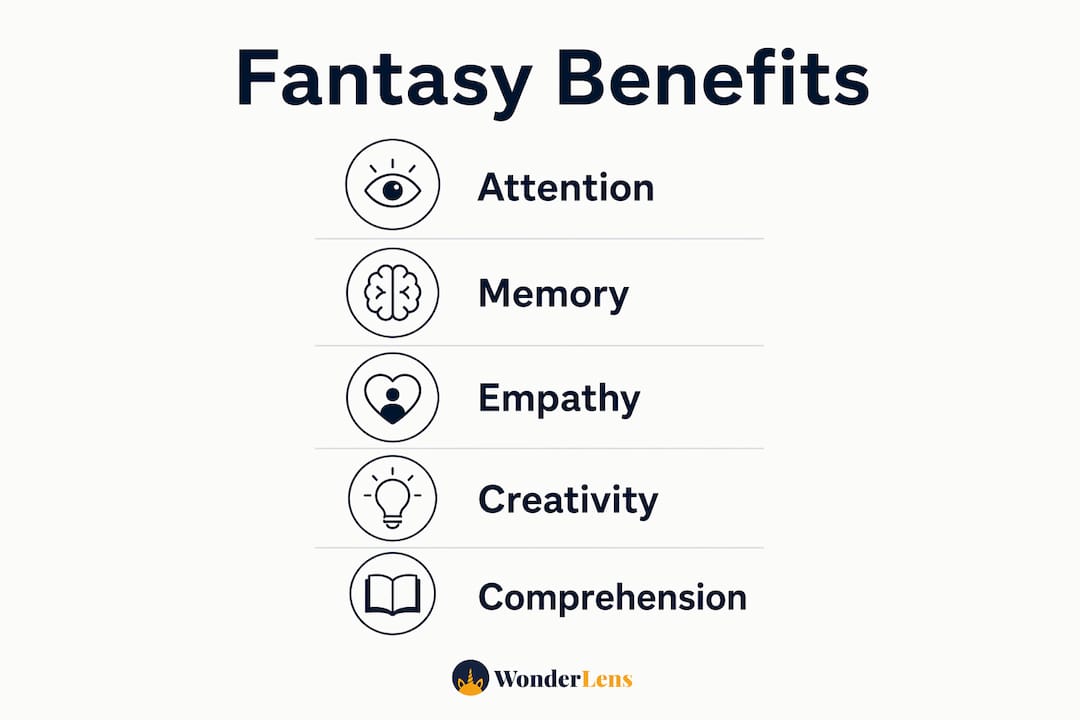
When a child encounters an impossible event, like a unicorn standing in the living room, their brain registers a prediction error. That surprise response sharpens attention and deepens the processing of whatever comes next, whether it's a new word, a lesson, or a story beat. A 5-week pretend-play intervention with 110 preschoolers found measurable gains in working memory and attention-shifting for children in the fantastical play group compared to both non-imaginative play and control groups.
The social-emotional gains are just as real. Perspective-taking through fantasy trains the neural circuits involved in empathy by asking children to imagine another being's inner world. Mar and Oatley's work on narrative immersion supports this: inhabiting a character's viewpoint, even briefly, strengthens theory-of-mind skills. And for creativity, a meta-analysis on fantasy and divergent thinking found a significant positive effect size of 0.742 across included studies.
Creativity boost: A meta-analysis found a significant positive effect of fantasy on divergent thinking in children.
Fantasy also helps reluctant readers and younger children engage with sustained narrative, building comprehension and reading stamina over time.
How fantasy elements change attention, memory, and social skills
The mechanism is simpler than it sounds. When children see something that breaks their mental model of the world, their brains pause and pay closer attention. A dragon appearing behind the sofa triggers that pause. The child leans in, asks questions, and processes the scene more carefully than they would a familiar image.
Working memory gets a workout too. Following a fantasy character through a short story requires holding multiple details in mind at once: where the character came from, what it wants, what happens next. That mental juggling is exactly the kind of exercise that builds executive function in early childhood.
"Fantasy offers a way of using cognitive functions for mental exploration and metacognition of counterfactual or expanded realms beyond the perceived 'real world.'" — Weibel et al., as cited in PMC research on fantasy and empathy
Role-playing and perspective-taking round out the picture. When a fairy in your child's bedroom prompts them to ask, "What does she want?" or "Is she scared?", that's theory-of-mind practice happening naturally. A dragon teaching a new word works the same way: the novelty of the character makes the vocabulary stick.
When should you use fantasy figures?
Different occasions call for different kinds of magic. Here's a quick map of moments and the goals they serve.
- Holiday mornings (Christmas, Easter, Halloween): Build anticipation and wonder. A Santa walking through your living room on Christmas Eve creates a memory that outlasts any gift.
- Birthdays: Personalize the celebration. A dragon or superhero appearing in your child's own room makes the day feel uniquely theirs.
- Bedtime: Soothe and settle. A gentle fairy or friendly unicorn in a soft-lit bedroom scene signals that the night is safe and magical.
- Learning moments: Prime attention before a lesson. Introduce a fantastical character that "brings" a new concept, and the lesson lands more deeply.
- Rewards: Mark an achievement. A celebratory dragon roaring in the backyard turns "good job" into a moment worth remembering.
For toddlers (ages 2–4), keep characters soft, familiar, and friendly: fairies, bunnies, and gentle dragons work well. Early elementary children (ages 5–8) can handle more elaborate storylines and characters with a bit more edge, like dragons with personality or adventurous superheroes. Placing a magical figure in your child's real home environment also creates a shared focus of attention that pulls the whole family into the moment together.
Pro Tip: Fantasy figures work especially well as a holiday tradition anchor. Returning to the same character each year builds anticipation and deepens the emotional resonance of the occasion.
How to integrate fantasy figures into your home photos and videos
A believable, emotionally engaging video comes down to a few deliberate choices.
- Pick your character and goal. Choose a character that fits the occasion and your child's age. Decide what you want the video to do: surprise, soothe, teach, or celebrate.
- Choose a photo and angle. Use a real photo of your home. A natural angle at the child's eye level makes the character feel present, not pasted in.
- Frame the story. Give the character a reason to be there. "Santa is checking the fireplace" is more engaging than a character standing still.
- Set the timing and reveal. Plan when your child will see it. A morning reveal on a holiday, or a bedtime surprise, hits harder than a random afternoon showing.
- Add voice or text prompts. A short caption or voice note ("Look who visited last night!") guides the child's attention and deepens the story.
- Test before the reveal. Watch the video yourself first. Check that the lighting looks natural and the character fits the scene.
A few quick dos and don'ts: match the character's scale to the room, avoid dark or chaotic imagery for children under four, and keep videos short. Ten seconds of magic lands better than thirty seconds of confusion. You can learn more about adding animated characters to family photos for step-by-step examples.
Pro Tip: Use progressive revelation: introduce the character in an unexpected corner of the room rather than center-frame. Staggered reveals mimic natural novelty processing and keep children engaged longer.
What are your options for creating fantasy figure videos?
| Approach | Realism | Ease | Cost | Time | Privacy control |
|---|---|---|---|---|---|
| Manual/DIY editing (photo apps + video editor) | Low–medium | Hard | Low | High | Full |
| AR filters and phone apps | Medium | Easy | Free–low | Low | Moderate |
| Web-based AI services (browser-based platforms) | High | Easy | Low per video | Very low | Platform-dependent |
Manual editing gives you full control but demands real skill in compositing, lighting, and animation. AR filters are quick and fun, but the characters rarely match your room's lighting or cast realistic shadows, which breaks the illusion fast. Web-based AI platforms sit in the sweet spot for most parents: realistic lighting and shadow integration, browser-based simplicity, and no software to install. For the quickest, most believable result, a browser-based service is the practical choice. Wonderlens's approach to realism in digital media goes deeper on why lighting and shadow fidelity matter so much for the magic to hold.
Safety, consent, and privacy when sharing personalized videos
Creating magical memories is worth doing carefully. A short checklist before you share:
- Get consent for any image that includes other people's children, not just your own.
- Strip metadata from files before sharing publicly. Most phones embed GPS location data in photos by default.
- Avoid sharing exact home details (house numbers, street signs visible through windows) in publicly posted videos.
- Check the platform's privacy policy before uploading photos, especially regarding how images are stored or used for training.
- Download and share privately via direct message rather than public social posts when the video includes your home interior.
- Watermark if needed to discourage unauthorized reuse of your family's personalized content.
For younger children, avoid characters that are visually overwhelming or frightening. Intensely scary fantasy can be counterproductive for preschoolers, producing anxiety rather than wonder. Test the video yourself and gauge your child's comfort level before making it a surprise.
Pro Tip: Watch the video with your child the first time rather than leaving it as a solo discovery. Your presence turns the reveal into a shared memory and lets you read their reaction in real time.
How Wonderlens applies these ideas to create safe, realistic holiday surprises
Jeremiha, the founder of Wonderlens, built the platform around a simple observation: the magic of a fantasy figure only works when it looks like it actually belongs in your home. That means matching the room's light source, casting a shadow on the floor, and animating the character with natural movement rather than a looping sticker.
Wonderlens is a browser-based platform. You upload a photo of your home, choose a character (Santa, a dragon, a fairy, the Easter Bunny, and more), and receive a 10-second animated video where the character appears inside your actual space, with lighting and shadows calibrated to the scene. No app download, no design skills needed.
"Placing a magical figure in the child's real home environment encourages active co-participation and deeper parent-child interaction." — BoardGamesGuide on immersive play
A family using Wonderlens on Christmas Eve gets a video of Santa walking past their own fireplace. A parent celebrating a birthday gets a dragon roaring in their child's actual bedroom. These aren't generic animations. They're personalized keepsakes that feel real because the environment is real.
Pro Tip: Pair your Wonderlens video with a short handwritten note "from" the character to extend the story beyond the screen. Children who receive both a visual and a physical artifact engage with the narrative longer.
Key Takeaways
Fantasy figures integrated into personalized home videos boost children's attention, memory, empathy, and creativity while creating shared family moments that last well beyond the holiday.
| Point | Details |
|---|---|
| Fantasy sharpens attention | Impossible events trigger focused processing, helping children learn and retain more from the experience. |
| Executive function gains are real | A 5-week intervention with 110 preschoolers showed measurable working memory and attention-shift improvements from fantastical play. |
| Best occasions to use them | Holiday mornings, birthdays, bedtime, learning moments, and rewards all benefit from a well-placed fantasy reveal. |
| Privacy comes first | Strip metadata, share privately, and check platform policies before posting any video featuring your home or children. |
| Wonderlens makes it simple | Upload a home photo, pick a character, and get a realistic 10-second animated video with matched lighting and shadows. |
What parents often underestimate about fantasy figures
The research on fantasy and child development is solid, but most parents still think of these videos as pure entertainment. That framing undersells what's actually happening. When a child sees a unicorn standing in their own living room, they're not just delighted. They're practicing prediction, updating their mental model of the world, and asking "why" and "how" questions that are the foundation of scientific thinking.
The home environment is the key detail most people miss. A generic fantasy animation on a screen is passive. A fantasy figure that appears to stand on your child's actual rug, casting a shadow toward your actual lamp, pulls them into active engagement. That shift from passive viewer to active participant is where the real developmental value lives. Parents who treat these moments as learning opportunities, not just surprises, get more out of them. Ask your child what the dragon wants. Ask where the fairy came from. Let the story continue past the video.
Wonderlens brings the magic home
Every technique covered here, progressive revelation, matched lighting, personalized characters in real home environments, comes together in one place. Wonderlens gives you a realistic, cinematic 10-second animated video of your chosen fantasy character inside your own home photo, created in minutes from a browser with no design experience needed.
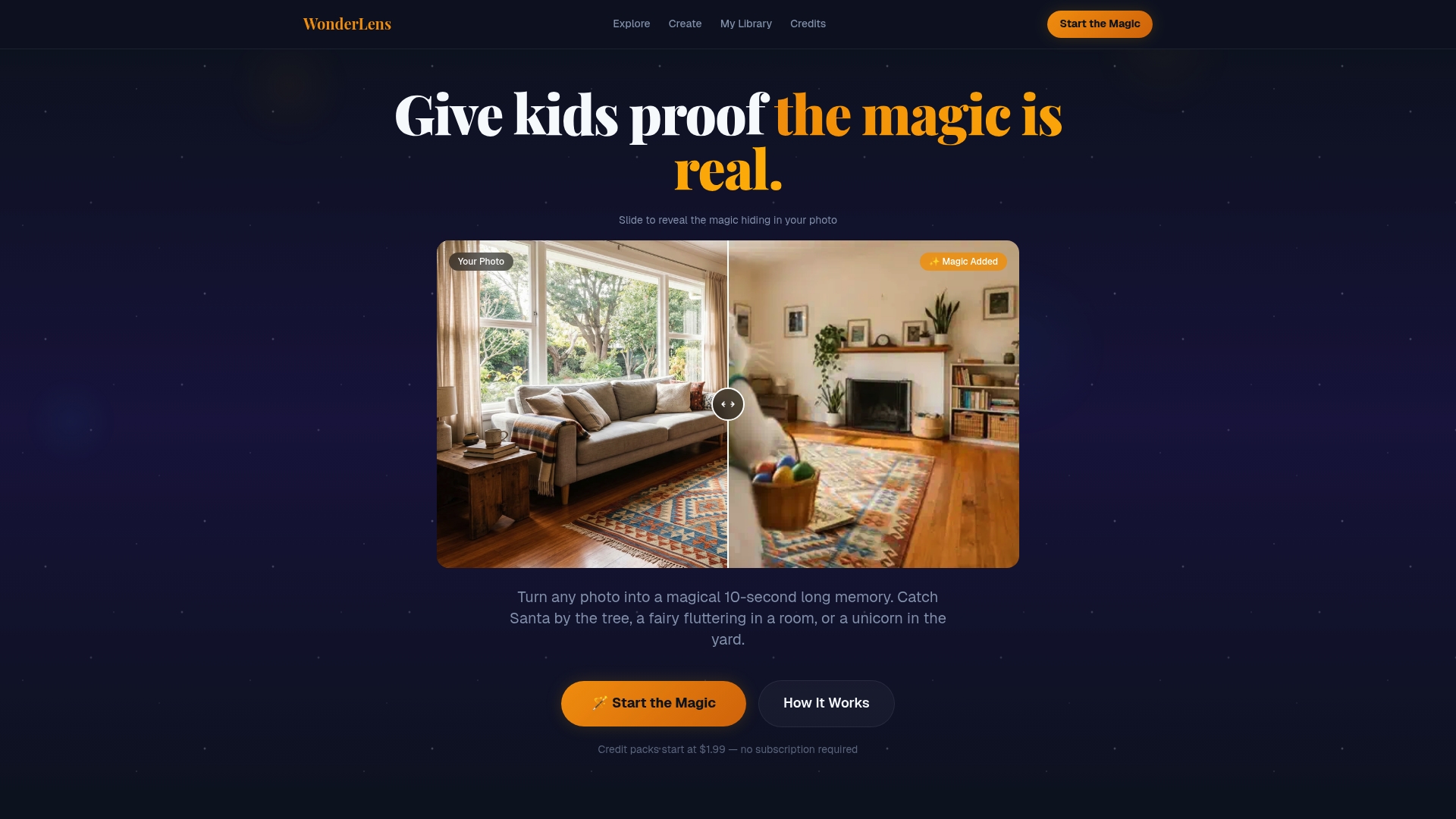
The first video is free. After that, credits start at $1.99 per video, so you can create a Santa reveal for Christmas, a dragon for a birthday, and a fairy for bedtime without any subscription. Make your first magical memory today and see what your child's face looks like when the magic shows up in their own room.
Further reading and sources
- Imagine That, Fantasy May Help Kids Learn — Scientific American: Start here if you want the clearest summary of how fantastical stories improve vocabulary and attention in children.
- Why Fantasy Matters Educationally — Human LibreTexts: Best for parents interested in the empathy and perspective-taking research.
- Fantastical Pretend-Play and Executive Functions — ScienceDirect: The experimental study with 110 preschoolers; read this if you want the working memory and attention data.
- Benefits of Fantasy Fiction and Imaginative Play — ParentingScience: Practical, parent-friendly summary of the research; good starting point for everyday application.
- Fantasy and Divergent Thinking Meta-Analysis — JPSE: The source for the 0.742 effect size on creativity; useful if you want the quantitative case.
- Fantasy, Empathy, and Metacognition — PMC: Deep dive into how fantasy engagement shapes emotional regulation and empathy; best for readers who want the neuroscience.
- The Role of Entertainment in Learning — Flight of Aloha: A broader look at how entertainment techniques connect to learning outcomes; good companion reading for the use-cases section.
- Why Monsters in Children's Literature Foster Imagination — Mark Watson Books: Explores the emotional and creative benefits of fantasy characters in children's stories; pairs well with the empathy and creativity points above.
Recommended
- Why integrating fantasy into home photos creates magic — WonderLens | WonderLens
- Fantasy Characters in Digital Media: A Family Guide. WonderLens | WonderLens
- Transform holidays: fantasy characters create magical family memories — WonderLens | WonderLens
- The Role of Fantasy Characters in Family Traditions. WonderLens | WonderLens